After a collision, visible damage draws immediate attention. Dented panels, broken lights, and scraped paint are easy to spot. What often goes unexamined is the structural damage underneath, and for vehicle owners seeking auto body repair in Downtown Little Rock, that hidden damage is where the real safety conversation begins.
Modern vehicles are built with complex frame systems engineered to behave in specific, controlled ways during a crash. When that structure is compromised, it affects how the vehicle handles, how safety systems respond, and how well the car protects occupants in another collision. At Bale Collision Center (Downtown), restoring that structure is a process built on manufacturer standards, not approximations. Advanced frame repair returns the vehicle to the exact dimensions and tolerances set by the manufacturer at the time of production, using precision measuring equipment, approved procedures, and technicians trained on how today’s vehicles are constructed.

How the Modern Vehicle Frame Works
The vehicle frame, also called the chassis, is the structural foundation that supports every other component in the car. It distributes the vehicle’s weight, provides mounting points for the suspension and drivetrain, and absorbs impact energy during a collision to protect passengers.
Most cars, crossovers, and smaller SUVs built today use a unibody design, where the body and frame are manufactured as a single integrated structure. Trucks and larger SUVs typically use body-on-frame construction, where the body is bolted onto a separate chassis rail system. These two designs behave differently in a crash and require different approaches during car body repair.
Unibody Frames
In a unibody vehicle, collision forces travel through the entire body structure. Damage to one area can affect alignment in areas that appear undamaged. Even a relatively low-speed impact can compromise a unibody more than a body-on-frame vehicle because the whole structure absorbs and distributes crash energy.
For example, a front-end collision on a sedan can shift the firewall alignment, alter the strut tower position, and affect rear door gap geometry, all from a single impact point.
Body-on-Frame Construction
In trucks and larger SUVs, chassis rails and crossmembers absorb the primary impact. Damage is often more localized, but it can still affect suspension mounting points, towing geometry, and wheel alignment when left uncorrected.
Modern Frame Materials and Their Impact on Structural Repair
Today’s vehicles use advanced steel grades that are stronger and lighter than older mild steel, but they require completely different repair methods. Using the wrong technique on these materials weakens the structure rather than restoring it.
Modern automotive steel falls into three primary categories:
- Mild Steel – Found in outer panels; can be reshaped using standard techniques
- High-Strength Steel (HSS) – Some grades allow limited cold straightening when the vehicle’s OEM, or Original Equipment Manufacturer, permits it in their published repair guidelines
- Ultra-High-Strength Steel (UHSS) – Extremely heat-sensitive; typically requires section replacement rather than straightening
Applying heat to UHSS components permanently reduces their engineered strength. A UHSS rocker panel or B-pillar that has been heat-straightened no longer provides the occupant protection it was designed to deliver, even if it looks intact from the outside.
Manufacturers like GM, Ford, Honda, and Toyota publish model-specific repair manuals that specify which components can be straightened, which require replacement, and whether heat is permitted at all. These are not general guidelines. They are precise, model-by-model instructions that must be followed to restore a vehicle to its original safety performance.
What Frame Damage Does to Vehicle Safety
A misaligned or damaged frame reduces crashworthiness, disrupts safety systems, and causes progressive mechanical wear across the vehicle. The effects are interconnected. Damage in one structural area creates problems that extend into multiple systems.
Crumple Zone Performance
Modern vehicles are constructed with crumple zones, which are engineered areas of the frame that collapse in a controlled pattern during a collision. These zones absorb energy before it reaches the passenger cabin and only function correctly when the frame is at factory dimensions.
A frame carrying residual misalignment after a collision changes how crumple zones respond. In a subsequent crash, energy that should be absorbed and redirected can instead transfer directly into the passenger compartment.
Airbag and Restraint System Function
Airbag sensors are calibrated to detect specific collision forces based on the vehicle’s structural geometry. When the frame shifts, sensor positions shift with it. A misaligned frame can delay or prevent airbag deployment at the exact moment it is most needed.
Seatbelt pretensioners, which tighten the belt during a crash to keep the occupant in position, are also tied to structural geometry. Misalignment can alter how and when these systems activate.
ADAS Sensor Accuracy
ADAS stands for Advanced Driver Assistance Systems, which includes features such as automatic emergency braking, lane departure warning, blind spot monitoring, and adaptive cruise control. These systems depend on sensors and cameras mounted throughout the vehicle, many of which are positioned at or near structural components.
When the frame shifts, sensor positions shift with it. A radar unit displaced by a small degree may calculate distances incorrectly, causing automatic braking to respond too late. Frame repair and ADAS recalibration are directly connected. Addressing the structure without recalibrating the sensors leaves the repair incomplete.
Suspension and Steering Alignment
The suspension and steering systems mount directly to the vehicle frame. When the frame bends or shifts, it misaligns the entire structure. The vehicle may drift on straight roads, produce vibration at highway speeds, or wear through tires unevenly after alignment. These are physical indicators that the vehicle’s structural geometry has moved outside of manufacturer specifications.
These are not just comfort-related symptoms. They indicate the foundation supporting every moving component in the vehicle is no longer where it needs to be. Body repair services that include computerized structural measurement are the only reliable way to confirm the extent of the misalignment.
Recognizing Frame Damage After a Collision
Frame damage does not always produce obvious external signs. Drivers who have been in a collision, even at low speeds, should watch for the following:
- Doors or trunks that no longer close flush or align correctly.
- Uneven gaps between body panels.
- Steering that pulls to one side on a straight road.
- Vibration felt through the steering wheel at highway speeds.
- Tires wearing unevenly after a fresh wheel alignment.
- Visible wrinkling or buckling in the floor pan or wheel well areas.
If any of these signs appear after a collision, the vehicle should be inspected before it is driven further. Visual inspection alone cannot detect misalignments within the tolerances that directly affect safety. When looking for auto body repair near you, confirm that the shop uses computerized frame measurement and can provide documented results before and after the repair.
Advanced Frame Repair Process
Proper frame repair follows a documented, multi-step process guided by OEM procedures, not generic techniques applied to all vehicles regardless of make or model. Each stage builds on the one before it.
Pre-Repair Scanning and Structural Measurement
The process begins before any physical work starts. Technicians mount the vehicle on a computerized frame measuring system that maps every structural reference point and compares current dimensions to the manufacturer’s factory specifications. This step identifies all misalignments, including damage with no visible surface indicators.
At the same time, an electronic pre-scan of the vehicle’s control modules records all stored fault codes, sensor disruptions, and calibration issues caused by the collision. This data shapes the full auto body repair plan, both structural and electronic, before a panel is touched.
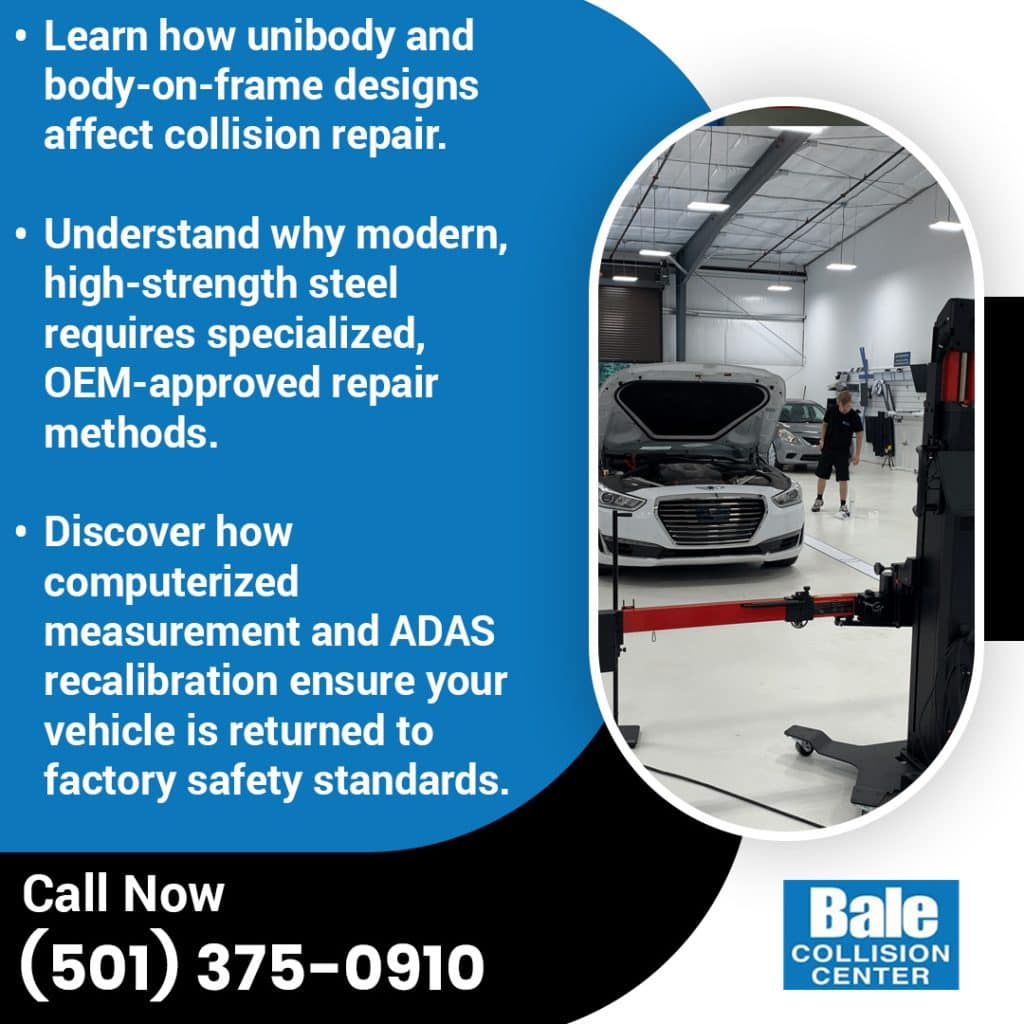
At Bale Collision Center, we use the Car-O-Liner frame rack and measuring system, a precision platform that identifies structural deviations across the full length and width of the vehicle.
Structural Correction to OEM Specifications
With damage fully documented, technicians use a hydraulic frame machine to apply controlled, directional force to return each structural point to its factory dimension. The process follows manufacturer-specific procedures for that exact make, model, and year.
Components made from UHSS that cannot be safely straightened are sectioned and replaced following the manufacturer’s published repair manual. Components where OEM guidelines permit straightening are corrected using cold techniques and measured continuously throughout the process. No step is assumed complete without measurement confirmation.
Approved Welding Procedures
When welding is required to replace structural sections or install new components, the equipment and technique are just as important as the repair itself. Bale Collision Center uses manufacturer-approved welding equipment that meets the standards required for modern automotive steel. Welding with approved methods keeps the surrounding steel at its engineered strength, so the repaired section performs as part of a unified, intact structure.
Battery disconnection protocols are also followed before welding begins, protecting electronic control modules from voltage disruptions that can damage sensitive systems.
Post-Repair Verification
After structural work is complete, the vehicle is measured again using the same computerized system. Every reference point is compared to OEM specifications to confirm the repair falls within the manufacturer’s accepted tolerances.
This post-repair measurement record serves as objective documentation that the structure was correctly restored. It provides a verifiable record for insurance purposes, future resale, and warranty compliance.
ADAS Recalibration
With the frame restored to factory dimensions, sensors affected by the collision or the car body repair process are recalibrated using advanced diagnostic equipment and manufacturer-approved procedures. Depending on the vehicle, this may include static calibration in a controlled shop environment, dynamic calibration during a supervised test drive, or both.
Sensor recalibration is a standard requirement of structural repair on modern vehicles, not an optional add-on. The alignment between frame geometry and sensor positioning is what allows safety systems to function as the manufacturer designed.
This process is not standard at every shop. When evaluating auto body repair near you, confirm that pre-repair scanning, structural measurement, and post-repair recalibration are included as part of every structural repair.
Choosing the Right Provider for Body Repair Services
When selecting a provider for body repair services that involve structural work, three factors determine whether a repair will meet safety standards: equipment, technician training, and OEM repair procedures.
Computerized Measuring Equipment
An auto body repair shop performing frame repair without a computerized measuring system has no objective method to confirm structural accuracy. Pre- and post-repair measurement documentation is the only verifiable record that the structure was restored to manufacturer specifications. At Bale Collision Center, every structural repair is measured using the Car-O-Liner system, and that documentation is part of every completed job we return to a customer.
Technician Training and Certification
Structural repair on modern vehicles requires technicians who hold active certifications and complete ongoing training as vehicle technology evolves. Certification at both the shop and individual technician level demonstrates that the people performing repairs meet recognized industry standards for knowledge, equipment use, and auto body repair procedures.
Bale Collision Center is I-CAR Gold Class certified, and our technicians hold I-CAR Platinum individual recognition. I-CAR, the Inter-Industry Conference on Auto Collision Repair, is the primary training and certification organization for the collision repair industry. Gold Class means the shop meets active, ongoing training requirements across all repair roles. Platinum individual certification means each technician has demonstrated advanced, current knowledge of collision repair methods.
OEM Repair Procedures
OEM procedures are the step-by-step repair instructions published by the vehicle’s manufacturer, covering material handling, approved repair methods, and recalibration requirements specific to that exact make, model, and year. A repair that follows OEM procedures meets the standard the manufacturer set for that vehicle’s safety performance. One that does not may look complete from the outside while leaving the structure outside of the tolerances the vehicle was designed to meet.
At Bale Collision Center, following OEM procedures is a fixed requirement of every structural repair, not an optional upgrade. Our technicians apply the manufacturer’s published specifications to every decision made on the vehicle. For drivers looking for auto body repair in Downtown Little Rock, that commitment means the repaired vehicle is held to the same structural standard it left the factory with.
Frame Repair and Long-Term Vehicle Value
Properly documented frame repair protects both occupant safety and the vehicle’s long-term resale value. Vehicle history reports flag frame damage. Buyers and dealerships treat undocumented structural repairs as a risk factor when evaluating a vehicle.
Documentation showing that repairs were completed to OEM specifications, with pre- and post-repair measurements on file, demonstrates that the vehicle was properly restored. This gives future buyers a factual basis for confidence and helps preserve the vehicle’s value over time.
Improper or undocumented structural repairs can void manufacturer warranty coverage on structural components and leave the vehicle’s crash performance in an unknown state.
Certified Auto Body Repair in Downtown Little Rock
Frame repair on modern vehicles is precise, technically demanding work. It requires accurate diagnosis, correct materials handling, proper equipment, and thorough verification, all guided by the manufacturer’s own published specifications.
Bale Collision Center provides structural car body repair held to OEM standards, serving Downtown Little Rock and the surrounding communities. Drivers across the area rely on us for repairs that address what matters most: restoring the structure, the safety systems, and the confidence that comes with knowing the repair was done right. We coordinate directly with all major insurance carriers and provide twice-weekly updates throughout the process.
Call us at (501) 375-0910 or email bccdowntown@baleautomotive.com to schedule your estimate and experience auto body repair near you that is built on verified, OEM-standard structural restoration.

