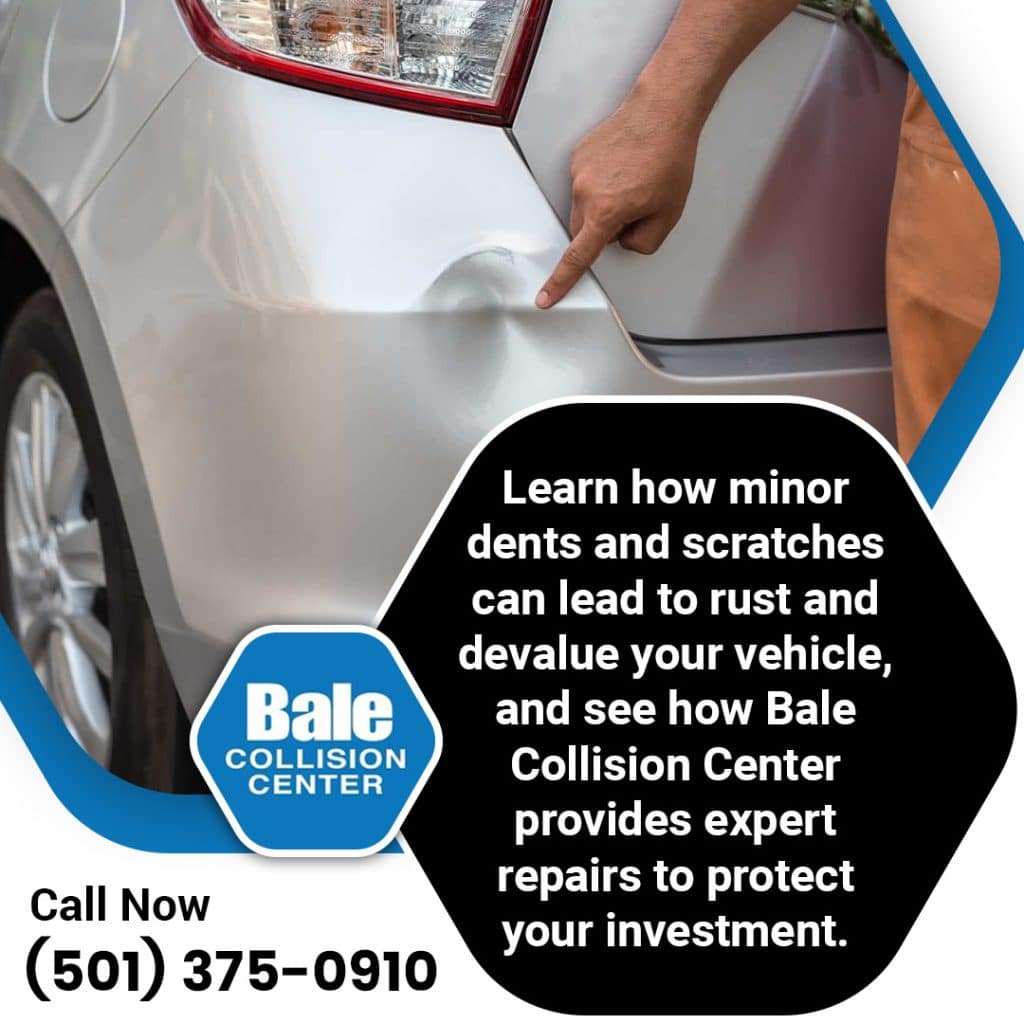
Parking lots are where most vehicles collect their first dents. A neighboring car door swings wide, a shopping cart drifts off course, or a driver misjudges a tight space. You return to find damage you had no part in causing. It is one of the most common frustrations vehicle owners face, and Little Rock drivers deal with it regularly. Most of those incidents leave behind exactly the kind of door dings, paint scrapes, and panel dents that a qualified body shop handles every day.
Bale Collision Center (Downtown) has been handling door dings, panel dents, and everything in between for Little Rock drivers since 1952. Over seven decades of repairs have made our auto body shop in Downtown Little Rock a familiar name for drivers who want the job done right the first time.
The Most Common Types of Parking Lot Damage
Parking lot damage falls into five primary categories: door dings, shopping cart impacts, paint transfer, surface scratches, and low-speed scuff marks. Each type has distinct characteristics that guide a technician’s repair decisions.
Door Dings
Door dings are the most frequent type of parking lot damage seen at a body shop. They appear as small, round impressions caused by an adjacent vehicle’s door swinging open in a tight space. Most door dings affect only the outer panel and leave the factory paint intact, which makes them strong candidates for a non-invasive repair method called Paintless Dent Repair (PDR).
PDR is a technique that restores dented metal to its original shape using specialized tools, without sanding, filling, or repainting the affected panel. More on this method is covered in the repair section below.
Shopping Cart and Debris Impacts
Shopping cart impacts produce larger, more irregular dents than door dings. The damage pattern depends on the cart’s angle and speed at contact, and these dents often appear on doors and quarter panels. Falling objects, low-hanging branches, and wind-driven debris in parking areas create similar irregular dent patterns.
Paint Transfer and Surface Scratches
Paint transfer appears as colored streaks or smudges on your panel where another vehicle or object made direct contact. It is typically surface-level, but the friction involved can also scratch the clear coat beneath. Surface scratches range from light, clear coat marks to deeper gouges that reach the primer or bare metal. The depth of the scratch determines whether a polish treatment is enough or whether panel refinishing is necessary.
Low-Speed Scuff Marks
Scuff marks are common on bumpers and lower body panels. Backing into a parking curb, brushing against a concrete pillar in a garage, or making slight contact with another bumper in a tight space are all typical causes. While scuffs often appear cosmetic, they can remove the protective clear coat layer and leave the panel vulnerable to moisture and UV damage.
Identifying the correct damage category is what allows a technician to recommend the right repair method from the start. If you are unsure which category your vehicle’s damage falls into, an inspection at a qualified auto body shop near you will give you a clear and accurate picture before any repair decisions are made.
Why Untreated Parking Lot Damage Gets Worse Over Time
Parking lot dings left unrepaired can progress from cosmetic issues into rust, structural weakening, and far more involved repairs, often within a few months in Arkansas’s humid climate. This is not an abstract concern. It follows a predictable sequence that technicians at an auto body shop see regularly.
Stage 1: Paint and Clear Coat Stress
Impact force creates micro-fractures in a vehicle’s protective coating layers, even when the visible damage looks minor. These micro-fractures may not be immediately visible, but they compromise the paint’s ability to seal out moisture and UV radiation. Temperature swings between Little Rock’s hot summers and cold winters expand and contract these fractures over time, widening the opening for damage to develop further.
Stage 2: Moisture Infiltration
Dented surfaces collect water more readily than smooth panels. Rain, humidity, car washes, and morning dew settle into depressions where natural drainage does not occur. Once moisture reaches bare or weakened metal through fractured paint, oxidation begins. Arkansas’s climate creates conditions where this process moves faster than it would in drier regions.
Stage 3: Rust Formation
Corrosion spreads laterally beneath the paint surface, away from the original dent. It often becomes visible only after substantial degradation has already occurred beneath the finish. At this stage, what was a straightforward dent repair now requires rust treatment, metal preparation, and full panel refinishing. The original repair scope has grown considerably.
Stage 4: Metal Fatigue
Dented panels in high-stress areas, such as door edges or quarter panels near hinges, undergo repeated stress cycles during everyday use. Every time the door opens and closes, the deformed area absorbs force it was not designed to handle. Over time, this weakens the panel’s structural integrity and can lead to cracking in ways that are difficult to fully reverse.
Addressing parking lot damage early keeps repair requirements at their most manageable level and protects the vehicle’s long-term condition and value. Knowing this progression exists is reason enough to have any new parking lot damage evaluated promptly by a qualified auto body shop near you rather than waiting to see whether it worsens on its own.
How a Body Shop Assesses Parking Lot Damage
A qualified auto body shop begins every parking lot repair with a structured damage assessment, not an immediate repair estimate. The inspection findings determine which repair method is appropriate, which protects the customer from unnecessary work and the vehicle from being repaired with the wrong technique.
Visual and Physical Inspection
Technicians evaluate four specific factors during the initial assessment.
- Paint condition is the primary determinant of the repair method. Intact factory paint with no chips or cracks indicates PDR may be appropriate. Any break in the paint surface shifts the repair toward traditional bodywork.
- Metal condition is assessed by determining whether the metal has been displaced or stretched. Displaced metal has been pushed inward but retains its structural integrity and can be restored through PDR. Stretched metal has been deformed beyond its elastic limit and cannot return to its original shape through PDR alone.
- Dent depth and location affect both method selection and tool accessibility. Dents on flat, open panel surfaces are more accessible for PDR tools than dents near body lines, door edges, or panel seams, where tools cannot reach behind the damage.
- Signs of prior damage or rust are identified during inspection because hidden corrosion beneath the paint affects the repair approach. Proceeding without addressing existing rust produces a cosmetically acceptable surface with structural problems developing underneath.
Pre-Repair Vehicle Scan
Late-model vehicles are equipped with ADAS, which stands for Advanced Driver Assistance Systems. These are electronic safety components that include lane departure warning sensors, parking cameras, blind-spot monitors, and adaptive cruise control modules. An impact that appears purely cosmetic can affect these systems.
A pre-repair scan using professional-grade diagnostic tools checks whether any ADAS components were affected by the parking lot impact. Missing this step creates a liability for the vehicle owner when safety systems malfunction after what appeared to be a minor repair.
Every one of these assessment steps, from visual inspection to pre-repair scanning, reflects the standard of care you should expect from the best auto body shops in your area.
Paintless Dent Repair: The Preferred Method for Intact Paint
PDR is the preferred repair method for parking lot dings when three conditions are met: the factory paint is intact, the metal has not been stretched, and the dent is in an accessible location.
The PDR process involves accessing the back side of the damaged panel and using precision tools to gradually massage the metal back into its factory position. Because the paint surface is never disturbed, the vehicle retains its original factory finish. Original factory paint is more durable than a refinished surface, and preserving it maintains the vehicle’s resale value more effectively than a repainted panel.
When PDR Is Not Appropriate
PDR is not the right method when paint is chipped or cracked, when metal has been stretched, when rust has already initiated, or when the dent is located near structural components or panel edges where tool access is limited. In these cases, traditional bodywork produces the correct result. Applying PDR to damage that requires traditional repair produces an inferior outcome and may allow hidden issues to continue developing beneath the surface.
Traditional Auto Body Repair: A Step-by-Step Overview
Traditional bodywork is required when parking lot damage involves paint breaks, rust, stretched metal, or locations that PDR tools cannot reach. It is a more involved process, but it is the correct method when the damage warrants it.
Metal Work and Rust Treatment
Technicians use specialized body tools to reshape or replace the damaged panel. If rust has formed, it is removed before any surface work begins. Surrounding metal is treated to stop continued oxidation and prepared properly for the materials applied above it. Skipping rust treatment and refinishing over it creates a surface that deteriorates rapidly from beneath.
Surface Preparation
The repaired area is sanded, primed, and prepared to create a flat, smooth base. This step directly affects how well the paint adheres and how long the finish lasts. Proper preparation is one of the most time-intensive parts of the process and one of the most consequential for long-term quality.
Color Matching and Paint Application
Professional body shops use camera-assisted paint-matching tools to formulate an accurate color match for the specific vehicle. Paint is applied in multiple layers following the same system used in the original factory finish: primer, base coat, and clear coat. Each layer requires proper curing time before the next is applied.
Finishing and Blending
The refinished panel is buffed, polished, and blended with adjacent panels. Proper blending is what makes repairs invisible to the eye. A repair that stops at the panel edge without blending into the surrounding surfaces often shows a color or texture difference that is visible in direct light.
Post-Repair Scanning and Final Inspection
After repairs are complete, a post-repair scan is performed to confirm that all vehicle systems, including ADAS components, are functioning correctly before the vehicle is returned to the owner.
The post-scan data is compared against the pre-scan results to confirm that no new electronic issues were introduced during the repair and that any impact-related concerns identified before work began have been fully addressed. For vehicles where sensors or cameras are near the repaired area, ADAS recalibration may be required to reset the system’s spatial reference points.
The final quality inspection covers panel alignment, paint finish accuracy, color match quality, and confirmation that all trim, hardware, and connections are properly restored to pre-damage condition. At any reputable shop, this final inspection is the last checkpoint between the repair bay and the road.

What Makes Bale Collision Center the Right Choice for Parking Lot Repairs
Repair quality varies from one auto body shop in Downtown Little Rock to the next, and those differences become apparent in how a repair holds up over time. At Bale Collision Center, our qualifications are independently verified, not self-reported.
Shop-Level Certification
Our shop holds I-CAR Gold Class certification, the highest shop-level recognition issued by I-CAR (Inter-Industry Conference on Auto Collision Repair), the nonprofit organization that sets training standards for the collision repair industry. Gold Class status requires that every role in the shop, including estimators, technicians, and production staff, maintain current training in their respective areas. It is a standard that reflects the entire team, not just individual technicians.
Technician Credentials
Our technicians at Bale Collision Center hold I-CAR Platinum certification, the highest individual technician credential available. Platinum-certified technicians demonstrate current knowledge of repair methods, materials, and evolving vehicle technology through ongoing role-specific training requirements. Our team also carries ASE (Automotive Service Excellence) certifications, awarded to technicians who pass standardized competency exams in specific repair disciplines.
Seven Decades of Local Experience
Beyond certifications, Bale Collision Center brings over 70 years of hands-on experience repairing vehicles for Little Rock families. That depth of experience, combined with independently verified training standards, is what separates the best auto body shops from facilities that simply perform repairs without a structured commitment to quality.
Get Your Vehicle Restored at a Trusted Auto Body Shop in Downtown Little Rock
Bale Collision Center has served Little Rock drivers since 1952. We handle both PDR and traditional bodywork, work directly with all major insurance carriers, and manage the claims process on your behalf from start to finish. Every repair follows OEM procedures, and every vehicle receives a pre-scan and post-scan before leaving our facility.
If you are looking for a dependable auto body shop near you, contact Bale Collision Center at (501) 375-0910 or email bccdowntown@baleautomotive.com to schedule a damage assessment. Parking lot damage addressed early remains straightforward to repair. Left to progress through time and Arkansas weather, it rarely stays that way.

