
SUMMARY
A small dent with intact paint may seem harmless, but whether you should repair it depends on where the dent is located, how deep or sharply creased it is, the condition of the metal, and your plans for the vehicle.
- If the factory paint remains intact and the dent is suitable, paintless dent repair (PDR) may be an option.
- PDR reshapes the damaged panel without conventional sanding, body filler, primer, or repainting when the damage qualifies.
- Small dents can still affect your vehicle’s appearance and may matter when selling, trading, or returning a leased vehicle.
- Not every dent is suitable for PDR. Sharp creases, stretched metal, inaccessible damage, panel-edge damage, or damage involving structural areas may require a different repair method.
- A dent caused by a collision should be evaluated for more than appearance because the impact may have affected components behind the panel.
- If the paint later cracks or chips, exposed metal on a steel panel can become vulnerable to corrosion.
- Repairing a suitable dent while the original finish remains undamaged may allow technicians to preserve the factory paint rather than refinishing the panel.
For drivers in Chenal and Little Rock, Bale Collision Center at 13101 Chenal Pkwy, Little Rock, AR 72211, United States provides professional paintless dent repair and auto body repair for qualifying vehicle damage.
Introduction
You walk toward your vehicle and notice something that was not there yesterday.
A small dent.
Maybe another car door bumped your vehicle in a parking lot. Perhaps a shopping cart rolled into a body panel. Maybe a minor impact left a shallow indentation but did not scratch or chip the paint.
The vehicle drives normally. The paint still looks good. The dent may only be noticeable when sunlight hits the panel from a certain angle.
So, do you really need to repair it?
Not necessarily from an urgent mechanical standpoint. But there are several good reasons to have the damage evaluated, particularly when the factory paint remains intact.
A small dent with undamaged paint may be a good candidate for paintless dent repair, commonly called PDR. This repair technique can reshape qualifying damage while preserving the existing painted finish.
However, not every small dent is purely cosmetic, and not every dent qualifies for PDR.
Understanding the difference can help you decide whether to repair the damage now, monitor it, or have a collision repair professional inspect the vehicle first.
Bale Collision Center provides paintless dent repair along with collision repair and other body repair services for Chenal and Little Rock-area drivers.
What Is a Small Car Dent?
A small dent is a localized deformation in a vehicle’s body panel.
Common causes include:
- Car doors
- Shopping carts
- Falling objects
- Minor parking incidents
- Road debris
- Low-speed contact
Small dents frequently occur on:
- Doors
- Fenders
- Quarter panels
- Hoods
- Roof panels
The size of the dent is only one part of determining how it should be repaired.
Technicians also consider:
- Depth
- Shape
- Location
- Metal condition
- Paint condition
- Accessibility behind the panel
A broad, shallow dent can sometimes be easier to repair than a smaller but extremely sharp crease.
Should You Repair a Small Dent if the Paint Is Still Intact?
In many cases, repairing it can make sense, especially if the dent qualifies for PDR.
Reasons include:
- Restoring the vehicle’s appearance
- Preserving the original finish
- Addressing damage before selling or trading the vehicle
- Avoiding a visible defect during a lease return
- Determining whether the dent is truly limited to the exterior panel
However, not every small dent requires immediate repair.
If the damage is purely cosmetic and you are comfortable with its appearance, there may be no urgent reason to repair it.
The important step is understanding what caused the dent and what was affected before assuming it is harmless.
What Is Paintless Dent Repair?
Paintless dent repair is a specialized technique for correcting certain dents without conventional refinishing.
Rather than sanding the panel, applying body filler, priming, and repainting, a trained technician works the damaged metal back toward its intended shape while preserving the existing finish.
Depending on the location and type of damage, technicians may use:
- Specialized rods
- Picks
- Leverage tools
- Controlled pushing techniques
- Exterior pulling techniques
The process requires precision.
Applying too much force in the wrong area can create:
- High spots
- Cracked paint
- Distorted metal
Professional PDR is therefore much more than simply pushing on the back of a dent.
What Are the Benefits of Paintless Dent Repair?
When the damage qualifies, PDR offers several potential advantages.
It can preserve the factory finish.
Because the panel does not need conventional refinishing, the original paint can remain intact.
It avoids body filler for qualifying dents.
The repair focuses on reshaping the original panel rather than filling the depression.
It can reduce refinishing operations.
A conventional repair may involve:
- Sanding
- Body filler
- Primer
- Basecoat
- Clearcoat
PDR may avoid these operations when the paint and panel condition allow it.
It may take less time.
Some uncomplicated PDR repairs can be completed more quickly than conventional body and refinishing work.
Actual repair time depends on the dent.
How Do Technicians Determine Whether a Dent Qualifies for PDR?
Technicians evaluate several factors.
Paint condition
The finish generally needs to remain sufficiently intact and flexible for the repair.
Dent depth
Extremely serious damage can stretch the metal beyond what can reasonably be restored using PDR.
Dent shape
A shallow depression may respond differently from a sharp crease.
Location
Damage close to:
- Panel edges
- Reinforcements
- Body lines
can be more difficult.
Access
Technicians often need appropriate access behind the damaged area or another suitable method for manipulating the panel.
Panel material
Steel and aluminum can behave differently during repair and may require different techniques.
The best way to determine whether PDR is appropriate is to have the actual dent inspected.
Does the Size of a Dent Determine Whether PDR Will Work?
Not by itself.
A common misconception is:
Small dent = easy PDR repair.
That is not always true.
A tiny but extremely sharp dent can be more difficult than a larger, shallow depression.
Technicians need to consider:
- Depth
- Sharpness
- Metal stretch
- Location
- Paint condition
rather than diameter alone.
Why Does Dent Depth Matter?
When metal is pushed inward, it changes shape.
A shallow dent may involve relatively limited deformation.
A deep impact can stretch the metal more significantly.
Once the material has been substantially stretched, simply manipulating it outward may not produce the desired panel shape.
That can make conventional auto body repair more appropriate.
Can PDR Repair a Creased Dent?
Sometimes.
A crease does not automatically rule out PDR.
However, technicians need to evaluate:
- Crease sharpness
- Length
- Depth
- Location
- Paint condition
- Metal stretch
A soft crease may be repairable using paintless methods.
An extremely sharp crease or heavily stretched panel may require conventional repair.
Can PDR Fix a Dent on a Body Line?
Potentially.
Body lines are intentionally shaped contours in exterior panels.
A dent directly across one can be more challenging because the repair must recreate the original contour rather than simply remove a depression from a relatively flat surface.
Experienced PDR technicians may be able to repair some body-line dents.
Others may require conventional repair depending on severity.
Can PDR Repair a Dent Near the Edge of a Panel?
Sometimes, but panel-edge dents can be more difficult.
Edges can be:
- Stronger
- Folded
- Reinforced
- Difficult to access
A dent near the center of an accessible door skin may present a different repair situation from one directly against a hemmed edge.
Location matters as much as size.
Can Aluminum Dents Be Repaired With PDR?
Some can.
Aluminum behaves differently from steel, so technicians need to account for the material during repair.
Whether PDR is appropriate depends on:
- Damage
- Panel
- Accessibility
- Paint condition
- Metal deformation
A technician should identify the panel material before deciding how to repair it.
What if the Dent Is on a Plastic Bumper?
Paintless dent repair generally refers to reshaping metal body panels.
Plastic bumper damage is different.
A bumper cover may:
- Dent
- Deform
- Scratch
- Crack
Repairability depends on:
- Plastic type
- Damage severity
- Paint condition
- Sensor location
- OEM restrictions
Modern bumpers can also contain or cover ADAS components, so bumper damage should not automatically be treated like a small dent in a metal door.
Can a Small Dent Hide Additional Collision Damage?
Yes, depending on how the dent occurred.
If a shopping cart creates a shallow dent in the middle of a door skin, the damage may be limited to that panel.
But if another vehicle strikes your car and leaves what appears to be a small dent, technicians may need to consider what lies underneath.
Collision forces can affect:
- Brackets
- Reinforcements
- Inner structures
- Mounting points
- Sensors
I-CAR explains that collision damage can include direct damage at the impact area and indirect damage elsewhere as forces travel through the vehicle.
This is why the cause of the dent matters.
Is a Door Ding the Same as Collision Damage?
A door ding is a type of minor impact damage, usually caused when another vehicle’s door contacts your panel.
Most door dings are cosmetic.
Typical damage can include:
- Small indentation
- Paint transfer
- Light scratch
If the paint remains intact and the dent is accessible, the damage may be suitable for PDR.
Bale Collision Center offers paintless dent repair for qualifying dents and dings.
Should You Repair a Door Ding?
The decision often comes down to:
- Appearance
- Vehicle value
- Lease requirements
- Repair cost
- Your plans for the vehicle
A tiny door ding may not interfere with how the vehicle operates.
But if you plan to:
- Sell the vehicle
- Trade it
- Return a lease
Repairing visible dents can improve its overall presentation.
Multiple small dents can also make an otherwise well-maintained vehicle appear neglected.
Can an Undamaged Paint Finish Eventually Crack Around a Dent?
Potentially.
A dent changes the shape of both the panel and the coating over it.
Whether the paint remains intact depends on factors such as:
- Severity of deformation
- Age and condition of the finish
- Location
- Environmental exposure
A dent with intact paint today does not guarantee the finish will remain unchanged indefinitely.
If you notice:
- Cracking
- Chipping
- Flaking
have the area evaluated.
Can a Small Dent Cause Rust?
The dent itself does not automatically cause rust.
If a steel panel remains properly coated and the paint has not cracked, the underlying metal is still protected by the coating system.
The corrosion concern increases if the damage breaks through:
- Clearcoat
- Basecoat
- Primer
and exposes bare steel.
I-CAR emphasizes the importance of restoring corrosion protection when factory protective materials are disturbed during collision repair.
So an intact finish is a positive sign, but continue monitoring it for cracking or chipping.
Should You Try to Pop a Dent Out Yourself?
DIY dent repair videos can make the process look deceptively simple.
Methods often involve:
- Suction cups
- Hot water
- Hair dryers
- Glue pullers
- Household tools
Results vary considerably.
An uncontrolled DIY attempt can potentially:
- Crack the paint
- Create high spots
- Stretch the metal
- Damage the clearcoat
- Make the dent more difficult to repair
If preserving the factory finish matters to you, having the dent evaluated before experimenting with it can be worthwhile.
Do Suction Cups Work on Car Dents?
They can sometimes move broad, shallow areas, but that does not mean the panel has been professionally restored.
A dent can contain subtle:
- Low spots
- High spots
- Tension
that are difficult to see without proper lighting and experience.
Professional PDR involves gradually controlling the panel’s shape rather than simply pulling the center outward.
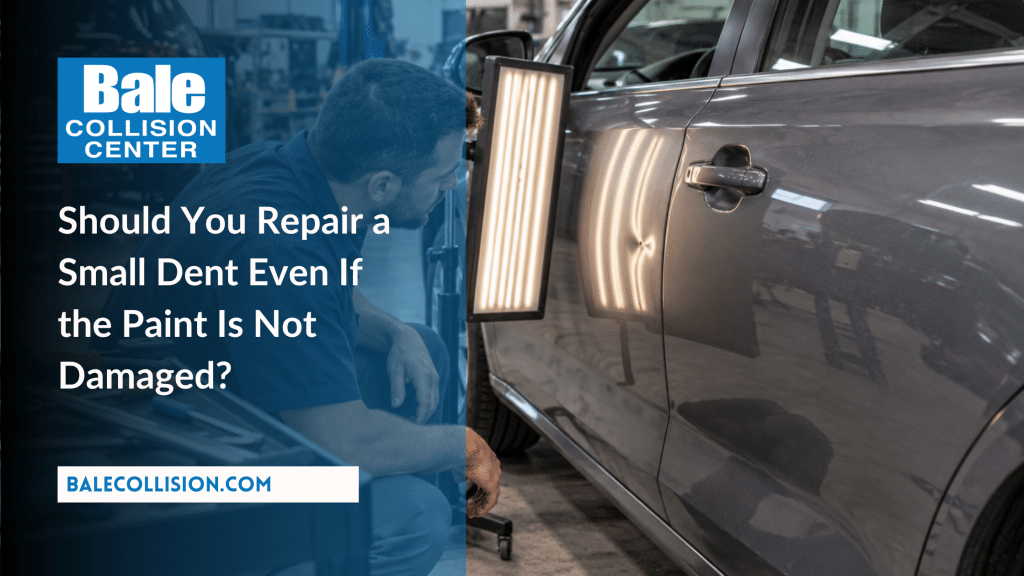
Why Do PDR Technicians Use Special Lighting?
Dent-repair lighting helps technicians see reflections across the panel.
Changes in those reflected lines reveal subtle:
- High spots
- Low spots
- Distortion
that may be difficult to recognize under ordinary lighting.
The technician uses those visual references while gradually manipulating the metal.
This precision is one reason professional PDR can produce a more refined result than simply trying to “pop” the dent outward.
Will PDR Damage the Paint?
The goal of PDR is to preserve the existing finish.
However, paint condition matters.
Older, previously refinished, cracked, or compromised paint may react differently during metal movement.
Technicians evaluate the finish before beginning.
If the paint is already damaged or unlikely to tolerate the necessary manipulation, another repair approach may be recommended.
Can PDR Be Used on Previously Repainted Panels?
Sometimes, but additional caution may be necessary.
A previously refinished panel may have:
- Different coating thickness
- Body filler underneath
- Different adhesion characteristics
than the original factory finish.
Those factors can affect repair strategy, particularly when exterior glue-pulling techniques are considered.
Tell the technician if you know the panel was repaired previously.
What if the Paint Is Already Cracked?
If the paint has cracked, PDR alone will not restore the coating.
The dent itself might still be manipulated as part of the repair process, but the finish may require conventional refinishing.
Depending on the damage, the repair can involve:
- Metal repair
- Surface preparation
- Primer
- Color application
- Clearcoat
Bale Collision Center provides auto paint services when damaged panels require refinishing.
Why Is Preserving Factory Paint Valuable?
When a dent can be corrected without refinishing, the original coating remains on the panel.
That avoids the need to reproduce:
- Color
- Metallic orientation
- Pearl appearance
- Clearcoat texture
through a conventional refinishing process.
Modern collision refinishing can produce excellent results, but if the original finish is still intact and the dent qualifies for PDR, preserving it can be an attractive option.
Will a Small Dent Affect Resale Value?
It can.
Buyers often judge a used vehicle partly by its exterior condition.
A visible dent may raise questions about:
- Previous accidents
- Vehicle care
- Other possible damage
One tiny dent may not dramatically change the vehicle’s value.
However, multiple dents or a prominent dent on a newer vehicle can influence its presentation during a private sale or trade-in.
Should You Repair a Dent Before Trading In Your Car?
It depends on the:
- Dent
- Vehicle
- Repair cost
- Expected trade value
If the dent is a straightforward PDR candidate, repairing it may improve the vehicle’s presentation.
However, it does not always make financial sense to repair every cosmetic imperfection before trading a vehicle.
Getting a repair estimate allows you to compare the cost against the potential benefit.
Should You Repair a Small Dent Before Returning a Lease?
Review your lease agreement.
Leasing companies commonly distinguish between normal wear and excessive damage.
A noticeable dent may be evaluated differently depending on:
- Size
- Location
- Number of dents
- Lease terms
If your lease is approaching its return date, having visible dents evaluated beforehand gives you time to compare repair options with potential lease-end charges.
Does Insurance Cover Small Dents?
It depends on:
- Cause of damage
- Policy
- Coverage
- Deductible
For example, damage caused by another vehicle may be handled differently from damage caused by:
- Hail
- Falling object
- Parking incident
If the repair cost is below or close to your deductible, filing a claim may not make financial sense.
Your insurance provider can explain how your policy applies.
How Much Does Paintless Dent Repair Cost?
There is no single price that accurately applies to every dent.
Cost can depend on:
- Dent size
- Depth
- Location
- Number of dents
- Panel material
- Access
- Body line involvement
- Complexity
A small accessible door ding can require far less work than a sharp crease in a difficult location.
The most accurate way to determine cost is to have the actual damage inspected.
Is PDR Always Cheaper Than Conventional Repair?
Not automatically.
PDR often avoids:
- Body filler
- Primer
- Basecoat
- Clearcoat
which can make it efficient for suitable damage.
But complicated PDR involving:
- Difficult access
- Sharp body lines
- Aluminum
- Extensive dents
can require substantial technician time.
The best repair method should be selected based on the damage rather than assuming one method is always cheaper.
How Long Does Paintless Dent Repair Take?
Repair time varies.
A straightforward small dent may require considerably less time than conventional body repair and refinishing.
More complex damage can take longer.
Factors include:
- Dent depth
- Location
- Number of dents
- Panel access
- Material
A professional inspection provides a better timeline than estimating from dent diameter alone.
Does the Panel Need to Be Removed for PDR?
Not always.
Technicians may gain access through:
- Existing openings
- Trim removal
- Interior panel removal
- Other service openings
In some cases, additional disassembly may be necessary to reach the back of the damaged area.
The goal is to obtain appropriate access without causing unnecessary damage.
What if There Is a Reinforcement Behind the Dent?
Reinforcements can limit direct access to the back of the outer panel.
Technicians may need to:
- Find an alternative access point
- Use a different PDR technique
- Consider exterior pulling
- Recommend conventional repair
The existence of a reinforcement does not automatically make PDR impossible, but it can change the repair strategy.
What if the Dent Was Caused by Hail?
PDR is commonly considered for certain hail dents when:
- Paint remains intact
- Damage is suitable
- Panels remain repairable
Hail damage can involve dozens or even hundreds of individual dents, so technicians evaluate the vehicle as a whole rather than treating every dent independently.
The number, depth, and location of dents influence the repair plan.
Is PDR Appropriate After a Collision?
Sometimes.
PDR is not limited to parking-lot door dings.
Certain collision-related dents may qualify when:
- Paint remains intact
- Panel is suitable
- Metal is not excessively stretched
- Structural damage is not involved
However, if another vehicle caused the dent, technicians should first determine whether the impact affected anything beyond the exterior panel.
Bale Collision Center provides both paintless dent repair and more extensive collision repair, allowing the repair approach to depend on the actual damage.
When Is Conventional Auto Body Repair a Better Option?
Conventional repair may be more appropriate when:
- Paint is cracked
- Metal is severely stretched
- Dent is extremely sharp
- Panel is torn
- Damage involves a structural component
- PDR access is impractical
- Panel replacement is required
Conventional repair can involve:
- Metal straightening
- Body filler when appropriate
- Sanding
- Primer
- Refinishing
The correct method depends on the condition of the panel.
When Should a Dented Panel Be Replaced?
A small dent does not automatically require panel replacement.
Replacement may become appropriate when:
- Damage is severe
- Metal is torn
- Repairability limits are exceeded
- Structural requirements call for replacement
- Repair is not technically or economically appropriate
OEM procedures can also influence repair-versus-replace decisions on certain components.
Can a Dent Affect ADAS?
A simple dent in the middle of an ordinary metal door is very different from damage in an area containing ADAS components.
Modern vehicles can have sensors around:
- Front bumper
- Rear bumper
- Grille
- Windshield
- Mirrors
NHTSA explains that driver-assistance systems can use cameras and other sensors to support technologies such as automatic emergency braking and blind-spot warning.
If the dent is near an ADAS component, the vehicle-specific repair requirements should be checked.
Does Every Dent Require ADAS Calibration?
No.
A small cosmetic dent does not automatically require calibration.
Calibration requirements depend on:
- Vehicle
- Sensor location
- Damage
- Components removed
- Repairs performed
- OEM procedures
If a repair does involve ADAS-related components, Bale Collision Center provides ADAS calibration services as part of its collision repair capabilities.
Should You Get a Small Dent Inspected Even if You Do Not Repair It?
It can be worthwhile when you are uncertain how the dent occurred or whether anything underneath was affected.
Professional evaluation can help answer:
- Is the damage purely cosmetic?
- Is the paint truly intact?
- Is PDR appropriate?
- Is the metal stretched?
- Is anything behind the panel damaged?
- Would conventional repair be better?
Once you know the answers, you can make a more informed decision about whether repairing the dent is worth it.
What Should You Ask a Dent Repair Shop?
Useful questions include:
- Is this dent suitable for PDR?
- Is the factory paint still intact?
- Is the metal stretched?
- Is the dent on a body line?
- Can you access the back of the panel?
- Has anything underneath been damaged?
- Would conventional repair provide a better result?
- Does the panel need refinishing?
- How long should the repair take?
A good recommendation should be based on the specific dent rather than simply assuming every small dent can be repaired the same way.
Frequently Asked Questions
Should I fix a small dent if the paint is not damaged?
You do not necessarily need to repair every cosmetic dent immediately, but repairing a qualifying dent can restore appearance while preserving the existing finish. A professional evaluation can determine whether PDR is appropriate.
What is paintless dent repair?
Paintless dent repair is a technique used to reshape certain damaged metal panels without conventional sanding, body filler, primer, and repainting.
Can every small dent be repaired with PDR?
No. Repairability depends on dent depth, shape, location, paint condition, metal stretch, panel material, and access.
Can a dent rust if the paint is not scratched?
A dent does not automatically cause rust if the protective coating on a steel panel remains intact. Corrosion becomes a greater concern if the finish cracks, chips, or exposes bare metal.
Can PDR repair dents on body lines?
Sometimes. Body-line dents can be more difficult because technicians need to restore the original contour. Repairability depends on severity and location.
Is PDR better than repainting?
Neither method is universally better. If a dent qualifies for PDR, preserving the original finish can be advantageous. Damage involving cracked paint, severe metal deformation, or other complications may require conventional repair.
Can a small dent hide collision damage?
Yes, particularly if another vehicle caused the dent. Depending on the impact location, technicians may need to inspect components beneath or behind the exterior panel.
Where can I get a small dent repaired in Chenal?
Bale Collision Center provides paintless dent repair and auto body repair at 13101 Chenal Pkwy, Little Rock, AR 72211, United States.
Professional Small Dent Repair in Chenal, Little Rock
A small dent with undamaged paint is not necessarily an emergency.
But it can present an excellent opportunity to determine whether the damage can be corrected without conventional repainting.
When the panel, metal, location, and paint condition are suitable, paintless dent repair can reshape the damaged area while preserving the existing finish. That makes PDR particularly useful for qualifying:
- Door dings
- Parking-lot dents
- Minor impact dents
- Other shallow body-panel damage
The important word is qualifying.
Not every small dent is a PDR candidate. Sharp creases, stretched metal, inaccessible damage, cracked paint, structural involvement, or damage in sensitive areas may require a different repair approach.
And when the dent resulted from an actual collision, technicians should consider whether the impact affected anything underneath the visible panel. I-CAR’s collision repair guidance emphasizes looking for both direct and indirect damage rather than assuming the visible defect represents the entire repair.
If you have a door ding, shallow dent, or other minor body damage, visit Bale Collision Center at 13101 Chenal Pkwy, Little Rock, AR 72211, United States.
Bale Collision Center provides paintless dent repair for qualifying damage as well as auto body repair and collision repair when more extensive repairs are necessary.
Chenal and Little Rock-area drivers can visit the Bale Collision Center Chenal location or contact Bale Collision Center to have a dent professionally evaluated.

