
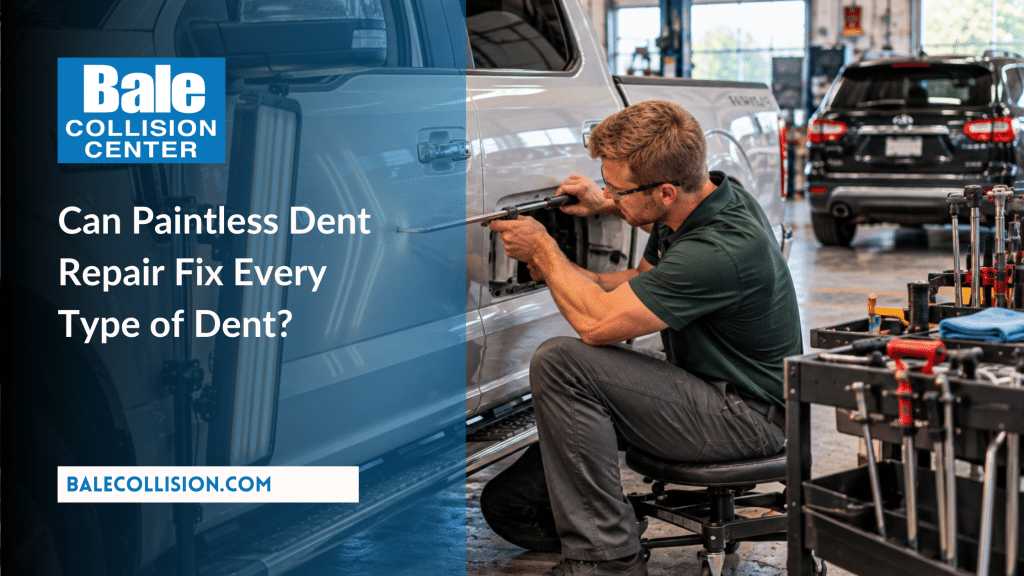
SUMMARY
- No, paintless dent repair (PDR) cannot fix every type of dent. It works best on qualifying dents where the original paint remains intact, and the damaged panel can be safely reshaped.
- Paintless dent repair is commonly used for door dings, hail damage, shallow dents, and certain minor parking-lot impacts.
- The effectiveness of PDR depends on the dent’s size, depth, location, shape, panel material, and accessibility.
- Sharp creases, severely stretched metal, cracked paint, torn panels, and structural damage may require traditional auto body repair or panel replacement.
- PDR can preserve the vehicle’s original factory finish when the damage qualifies, avoiding the need for conventional repainting.
- Not every small dent is suitable for PDR. A small, sharp dent on a body line may be more difficult to repair than a larger, shallow dent on a relatively flat panel.
- Aluminum and steel panels can sometimes be repaired using PDR, but their material properties and construction affect repairability.
- Paintless dent repair may be faster and less expensive than traditional dent repair for suitable damage, although actual costs and timelines vary.
- A professional inspection helps determine whether PDR, conventional body repair, refinishing, or panel replacement is appropriate.
- Drivers in Little Rock, Arkansas, can contact Bale Collision Center at 13101 Chenal Pkwy, Little Rock, AR 72211 to discuss dent repair options.
Can Paintless Dent Repair Fix Every Dent on a Vehicle?
Paintless dent repair is an effective method for correcting certain types of vehicle body damage, but it has limitations.
A small door ding may be an excellent candidate for PDR.
A deep crease with cracked paint may require traditional auto body repair.
Even two dents that appear similar can require different repair methods because of their location, shape, and the condition of the metal underneath.
The most important question is not simply how large the dent appears.
It is whether the damaged panel can be returned to an acceptable shape without compromising the paint, surrounding structure, or manufacturer repair requirements.
At Bale Collision Center, drivers can explore paintless dent repair services for qualifying damage.
When PDR is not appropriate, other auto body repair services may be necessary.
What Is Paintless Dent Repair?
Paintless dent repair, commonly called PDR, is a technique used to remove qualifying dents without conventional body filler or repainting.
Technicians use specialized tools and controlled pressure to gradually reshape the damaged panel.
Depending on the dent’s location, the technician may work from behind the panel or use an appropriate external pulling method.
How Does PDR Work?
A typical repair may involve:
- Inspecting the dent.
- Evaluating the paint condition.
- Identifying the panel material.
- Checking access to the damaged area.
- Selecting suitable repair tools.
- Gradually reshaping the metal.
- Inspecting the repaired surface.
The process requires precision.
Applying excessive force or using the wrong technique can damage the paint or create additional distortion.
Does Paintless Dent Repair Remove the Original Paint?
No.
The purpose of PDR is to restore the panel’s shape while preserving the existing finish.
That is one of its main advantages over conventional dent repair.
However, the paint must be suitable for the procedure.
If the coating is cracked, peeling, or otherwise compromised, a different repair method may be necessary.
What Types of Dents Can Paintless Dent Repair Usually Fix?
PDR is commonly considered for several types of minor exterior damage.
1. Door Dings
Door dings frequently occur in parking lots.
They may result from:
- Another vehicle’s door
- Shopping carts
- Accidental contact with nearby objects
Small, shallow door dings with intact paint can be good PDR candidates.
However, dents located along sharp body lines or reinforced areas may be more challenging.
2. Hail Damage
Hail can leave multiple dents across a vehicle’s exterior.
Commonly affected areas include:
- Hood
- Roof
- Trunk
- Upper doors
- Fenders
PDR is frequently used for qualifying hail dents because many are relatively shallow and do not break the paint.
However, severe hail damage can crack coatings, stretch metal, or affect areas that are difficult to access.
Not every hail dent can be repaired using PDR.
3. Shallow Parking-Lot Dents
Minor parking-lot impacts can create dents without damaging the paint.
Depending on the location and shape, PDR may be suitable.
Examples include:
- Light contact with another vehicle
- Shopping cart impacts
- Minor accidental contact
The repair method should be determined after inspecting the affected area.
4. Certain Minor Collision Dents
Some low-speed impacts produce dents that qualify for PDR.
However, the vehicle must be inspected for additional damage.
A dent caused by a collision may be associated with:
- Broken mounting brackets
- Panel misalignment
- Damaged reinforcement
- Other hidden concerns
PDR should not be used to conceal damage that requires additional repair.
Bale Collision Center also provides collision repair services for accidents involving more than superficial panel damage.
What Types of Dents Cannot Usually Be Fixed With PDR?
Several damage conditions can make PDR unsuitable.
These include:
- Severely stretched metal
- Torn panels
- Cracked paint
- Sharp damage beyond repairable limits
- Structural deformation
- Certain panel edges
- Inaccessible damage
- Manufacturer-restricted repair areas
The exact limits depend on the vehicle, panel material, and damage.
Can PDR Fix a Dent With Cracked Paint?
PDR generally is not a complete repair when the paint is cracked.
Although the metal may be reshapeable, the damaged coating still requires attention.
Cracked paint can expose underlying layers to moisture and contaminants.
Traditional repair and refinishing may be necessary.
Can PDR Fix a Deep Dent?
Sometimes, but not always.
Depth alone does not determine repairability.
A deep dent may involve excessive metal stretching or sharp deformation.
A professional inspection is needed to determine whether the panel can be reshaped appropriately.
Can PDR Fix a Dent With Torn Metal?
No.
PDR is not intended to repair torn or punctured metal.
Damage involving a tear may require conventional body repair or panel replacement, depending on manufacturer requirements.
Does Dent Size Determine Whether PDR Will Work?
Size matters, but it is only one factor.
A larger, shallow dent may sometimes be easier to repair than a smaller, sharply creased dent.
Technicians also consider:
- Dent depth
- Metal stretching
- Paint condition
- Panel curvature
- Access
- Damage location
Can a Large Dent Be Fixed With PDR?
Some larger dents can be repaired using PDR when the metal has not been excessively stretched, and the paint remains suitable.
However, larger dents often require more time and specialized techniques.
The size of the dent alone does not guarantee a successful repair.
Are Small Dents Always Easy to Repair?
No.
A small dent located on a sharp body line or near a reinforced section may be difficult to access or reshape.
A professional evaluation is more reliable than judging repairability based on size alone.
Can Paintless Dent Repair Fix Sharp Creases?
Some creases can be repaired using advanced PDR techniques.
However, sharply folded or severely stretched metal may not return to its original shape without conventional repair.
The technician must evaluate:
- Crease length
- Crease depth
- Metal condition
- Paint condition
- Panel location
Why Are Creases More Difficult Than Round Dents?
A round, shallow dent often spreads deformation over a relatively broad area.
A sharp crease concentrates deformation along a narrow line.
This can stretch the metal and place greater stress on the paint.
The more severe the deformation, the less likely PDR will be the appropriate solution.
Can PDR Repair Dents on Body Lines?
Sometimes.
Body lines are the raised or defined contours that give a vehicle its shape.
A dent directly on a body line can be more challenging because the metal has a specific contour.
Why Do Body Line Dents Require More Precision?
The technician must restore the contour without creating additional distortion.
Repairability depends on:
- Severity
- Metal condition
- Access
- Paint condition
- Manufacturer restrictions
Some body line dents qualify for PDR.
Others require conventional repair.
Can Paintless Dent Repair Fix Aluminum Panels?
Yes, certain aluminum panels can be repaired using PDR.
However, aluminum behaves differently from steel.
The technician must account for the material’s characteristics and the panel’s construction.
Is Aluminum Harder to Repair Than Steel?
Some aluminum dents can be more challenging because of the material’s response to deformation.
Repair difficulty depends on:
- Aluminum alloy
- Panel thickness
- Dent shape
- Damage location
- Manufacturer procedures
Not every aluminum panel is repairable.
Why Do Manufacturer Procedures Matter?
Vehicle manufacturers may specify restrictions on how certain components can be repaired.
The I-CAR Repairability Technical Support Portal provides resources for researching vehicle-specific repair procedures.
The appropriate repair method should follow applicable manufacturer guidance.
Can PDR Fix Dents on Plastic Bumpers?
Traditional PDR is primarily associated with reshaping suitable metal panels.
Plastic bumper covers require different repair considerations.
Some plastic deformation may be repairable using appropriate plastic repair methods.
However, this is not necessarily the same procedure as conventional PDR.
What if a Bumper Has a Dent but No Paint Damage?
The bumper should still be evaluated.
Modern bumper assemblies can contain:
- Reinforcement
- Energy absorbers
- Mounting brackets
- Parking sensors
- Radar sensors
An impact may affect components behind the bumper even when the cover appears relatively undamaged.
Bale Collision Center provides auto body repair for applicable bumper and exterior panel damage.
Can PDR Fix Dents on the Hood?
Yes, certain hood dents can qualify for PDR.
Examples include:
- Small hail dents
- Shallow impacts
- Minor parking-related damage
However, repairability depends on the hood’s material and construction.
What Makes Hood Dents Difficult to Repair?
Some hoods contain:
- Reinforcement
- Bonded sections
- Limited-access areas
- Complex contours
A dent directly over reinforcement may be harder to access.
The technician must also consider the condition of the paint and surrounding panel.
Can PDR Fix Dents on the Roof?
Yes.
Roof panels are common areas for hail damage.
PDR may be suitable when the dents are repairable, and the paint remains intact.
However, roof repair can involve additional access considerations.
Does the Headliner Need to Be Removed?
Sometimes.
Access requirements depend on the vehicle and dent location.
Removing interior components may be necessary for certain repairs.
Technicians must follow appropriate procedures when working around roof-mounted components, wiring, and restraint systems.
Can PDR Fix Dents on Doors?
Many door dents are suitable for PDR.
However, door construction can affect access.
Doors may contain:
- Window mechanisms
- Reinforcement
- Wiring
- Side-impact components
- Interior trim
Can a Dent Near the Door Edge Be Repaired?
Possibly.
Dents near edges and reinforced areas can be more challenging.
The technician must evaluate the location, metal condition, and available access.
If the impact affected the door’s structure, latch, or alignment, additional inspection may be necessary.
Can Paintless Dent Repair Fix Dents on Fenders?
Yes, certain fender dents qualify for PDR.
Fenders can be damaged by:
- Parking-lot incidents
- Minor impacts
- Road debris
- Hail
Repairability depends on the dent’s shape and the panel’s construction.
What if the Fender Is Bent Near the Wheel Opening?
Damage around wheel openings can be more complicated.
The repair facility may need to evaluate:
- Panel edge
- Mounting points
- Inner liner
- Wheel clearance
- Adjacent components
A dent involving significant deformation may require conventional repair.
Can PDR Fix Dents on Quarter Panels?
Some quarter-panel dents can be repaired using PDR.
However, quarter panels often have limited access because they are integrated into the vehicle body.
Why Are Quarter-Panel Dents Sometimes More Difficult?
Access may be restricted by:
- Inner body structure
- Trim
- Reinforcement
- Wheelhouse construction
The location and severity of the dent determine whether PDR is practical.
Can PDR Fix Dents Caused by a Collision?
Sometimes, but the vehicle should first be evaluated for collision-related damage.
A minor impact can affect more than the visible outer panel.
What Hidden Damage Might Be Present?
Depending on the collision, hidden damage may involve:
- Mounting brackets
- Reinforcement
- Adjacent panels
- Sensors
- Wiring
- Structural components
A dent that qualifies for PDR does not automatically mean the entire vehicle is free from other damage.
Why Is Inspection Important?
The purpose of an inspection is to determine whether the damage is limited to the exterior panel.
If additional components are affected, those concerns must be addressed separately.
The National Highway Traffic Safety Administration provides information about vehicle safety systems and the importance of maintaining safe vehicle operation.
Can PDR Affect Advanced Driver Assistance Systems?
PDR itself does not automatically require ADAS calibration.
However, the location of the damage and the repair operations may create additional requirements.
Modern vehicles may use cameras, radar sensors, and other technology for:
- Automatic emergency braking
- Lane keeping assistance
- Blind-spot monitoring
- Adaptive cruise control
- Parking assistance
The Insurance Institute for Highway Safety explains how these systems support drivers and why their limitations matter.
Does Every Dent Repair Require ADAS Calibration?
No.
Calibration requirements depend on the vehicle, damage location, installed systems, and repair procedures.
A shallow dent on an unrelated body panel may not require calibration.
A collision affecting a sensor mounting area may require further inspection or specific procedures.
Bale Collision Center provides ADAS services for applicable vehicle needs.
What Are the Benefits of Paintless Dent Repair?
PDR offers several advantages when the damage qualifies.
1. Preserves the Original Paint
PDR is designed to retain the existing factory finish.
This can avoid conventional repainting.
2. May Require Less Repair Time
Qualifying dents may be repaired without the additional stages involved in body filler application and refinishing.
3. May Reduce Repair Costs
Because PDR can avoid some traditional repair operations, it may be less expensive for suitable damage.
4. Avoids Conventional Repainting
PDR generally does not require new primer, basecoat, or clearcoat when the existing finish remains intact.
5. Can Be Useful for Multiple Hail Dents
PDR is commonly used for qualifying hail damage across multiple panels.
However, the final repair plan depends on the number, size, and severity of the dents.
What Are the Limitations of Paintless Dent Repair?
PDR is not appropriate for every situation.
Limitations can include:
- Damaged paint
- Excessively stretched metal
- Torn panels
- Limited access
- Severe creases
- Structural damage
- Manufacturer repair restrictions
Can PDR Make a Damaged Panel Worse?
Improper techniques can potentially damage paint or distort the panel.
That is why technician skill and an appropriate repair assessment matter.
How Does PDR Compare With Traditional Dent Repair?
Both methods have appropriate applications.
| Factor | Paintless Dent Repair | Traditional Dent Repair |
| Best suited for | Qualifying dents with intact paint | Dents involving paint damage or more extensive deformation |
| Repainting | Generally not required | May be required |
| Body filler | Generally not used | May be used when appropriate |
| Repair time | Often shorter for suitable damage | May involve additional preparation and refinishing |
| Cost | May be lower for qualifying dents | Depends on repair complexity |
| Severe damage | Limited suitability | Can address a wider range of repairable damage |
| Panel replacement | Not part of PDR | May be necessary for some damage |
Neither method is automatically better for every dent.
The correct choice depends on the panel and damage.
How Much Does Paintless Dent Repair Cost in Little Rock?
PDR pricing varies.
Important factors include:
- Dent size
- Dent depth
- Location
- Panel material
- Accessibility
- Number of dents
- Complexity
- Labor required
Is PDR Always Cheaper Than Traditional Dent Repair?
No.
PDR may be more economical for straightforward dents because conventional refinishing is avoided.
However, a complex dent requiring extensive access and specialized techniques may involve more labor.
An estimate is the best way to understand the cost for your vehicle.
Can Multiple Dents Increase the Price?
Yes.
The number and complexity of dents affect the total repair.
For example, multiple hail dents across the hood, roof, and trunk may require a different repair plan than a single door ding.
Drivers can contact Bale Collision Center to discuss repair options.
How Long Does Paintless Dent Repair Take?
Repair time depends on the damage.
A small, accessible dent may take less time than a large or complex dent.
Factors include:
- Dent shape
- Number of dents
- Panel access
- Material
- Technician workload
- Additional repairs
Can PDR Be Completed the Same Day?
Some qualifying repairs may be completed the same day.
However, this is not guaranteed.
More complicated dents or multiple damaged panels may require additional time.
The repair facility should provide a timeline after inspecting the vehicle.
Does Insurance Cover Paintless Dent Repair?
Coverage depends on the policy and cause of damage.
For example, hail damage and collision-related dents may be considered under different coverage provisions.
Important factors include:
- Insurance coverage
- Deductible
- Cause of damage
- Claim requirements
- Repair estimate
Should You File an Insurance Claim for a Small Dent?
That depends on the repair cost and your policy.
For a minor dent, some drivers may choose to pay directly.
Others may have qualifying insurance coverage.
Review the estimate and discuss coverage questions with your insurer before deciding.
Can You Fix a Dent Yourself Instead of Using PDR?
Some DIY dent removal methods are widely advertised.
However, results vary, and improper attempts can make damage worse.
Potential problems include:
- Cracked paint
- Stretched metal
- Additional distortion
- Damaged trim
- Damage to nearby components
Do Suction Cups Work on Every Dent?
No.
Simple pulling tools may not be effective on sharp creases, reinforced areas, or dents with significant deformation.
Even if a dent becomes less visible, that does not necessarily mean the panel has been restored correctly.
Can Hot Water Remove Every Dent?
No.
Hot water is not a universal dent repair method.
It can also introduce risks involving temperature-sensitive materials and finishes.
A professional inspection is the better approach when the dent’s repairability is uncertain.
When Should You Choose Traditional Auto Body Repair Instead of PDR?
Traditional repair may be more appropriate when:
- Paint is cracked
- Metal is torn
- Dent is severely creased
- Panel is excessively stretched
- Damage affects structural components
- Manufacturer procedures restrict repair
- Panel replacement is required
Bale Collision Center offers auto body repair and auto paint services for damage that requires more than PDR.
What if the Dent Also Has Scratches?
The paint condition must be evaluated.
If the scratch is limited to a superficial mark, the dent may still qualify for PDR, depending on the circumstances.
If the coating is cracked or metal is exposed, additional refinishing may be necessary.
Why Is Paint Damage Important After a Dent?
Automotive coatings help protect underlying materials from moisture and environmental exposure.
When paint is cracked, chipped, or scraped away, the underlying material may become vulnerable to corrosion.
This is particularly important when steel is exposed.
Can a Dent With Damaged Paint Rust?
Yes.
If the protective finish is compromised and steel is exposed, moisture and oxygen can contribute to rust formation.
The risk depends on the conditions and material.
Repairing the dent alone may not address the coating damage.
What Should Little Rock Drivers Look for in a PDR Shop?
Before approving a repair, ask how the facility evaluates dents.
Useful questions include:
- Is the paint intact?
- Is the panel suitable for PDR?
- Can the dent be accessed?
- Has the metal been stretched?
- Are there manufacturer repair restrictions?
- Is there hidden collision damage?
- Would traditional repair provide a better result?
- What is included in the estimate?
The shop should explain why a particular method is recommended.
How Does Bale Collision Center Evaluate Dent Repair Options?
Bale Collision Center offers services for both qualifying cosmetic dents and more extensive collision damage.
Its available services include:
The appropriate repair depends on the actual damage.
A shallow door ding may qualify for PDR.
A deep dent with cracked paint may require traditional repair and refinishing.
A collision involving underlying components may require a more comprehensive inspection.
Drivers can review Bale Collision Center’s available services before requesting an estimate.
What Happens During a Professional Dent Repair Estimate?
A dent repair estimate generally begins with an inspection.
Step 1: Examine the Dent
The technician evaluates the size, depth, shape, and location.
Step 2: Check the Paint
The condition of the existing finish helps determine whether PDR is suitable.
Step 3: Identify the Panel Material
Steel, aluminum, and other materials may require different repair considerations.
Step 4: Evaluate Accessibility
The technician determines whether the dent can be reached using appropriate methods.
Step 5: Check for Additional Damage
If the dent resulted from a collision, surrounding components may need inspection.
Step 6: Recommend the Repair Method
The shop explains whether PDR, conventional repair, refinishing, or replacement is appropriate.
Step 7: Review Cost and Timeline
The final estimate depends on the repair plan and vehicle.
How Can You Prevent Common Door Dings and Minor Dents?
Not every dent can be prevented.
However, careful parking and vehicle handling can reduce some risks.
Consider:
- Leaving reasonable space between parked vehicles
- Avoiding crowded parking areas when practical
- Being mindful of shopping carts
- Parking away from unsecured objects
- Using covered parking during severe hail forecasts when available
- Avoiding unnecessary contact with body panels
These precautions cannot eliminate every risk, but they may reduce exposure to common sources of minor damage.
Frequently Asked Questions
1. Can paintless dent repair fix every type of dent?
No. PDR works best on qualifying dents where the paint remains intact and the panel can be safely reshaped. Severe creases, torn metal, cracked paint, and structural damage may require other repair methods.
2. Can PDR fix large dents?
Sometimes. Larger dents may qualify when the metal has not been excessively stretched, and the paint remains suitable. Size alone does not determine repairability.
3. Can paintless dent repair fix dents with scratches?
It depends on the scratch. A superficial mark may not prevent PDR, but cracked paint or exposed metal can require additional repair and refinishing.
4. Can PDR fix dents on aluminum vehicles?
Yes, certain aluminum dents can be repaired using PDR. However, aluminum properties, panel construction, damage severity, and manufacturer procedures affect the repair method.
5. Is PDR cheaper than traditional dent repair?
It can be cheaper for suitable damage because repainting and some conventional repair operations may be avoided. Actual costs depend on the dent’s complexity and accessibility.
6. How long does paintless dent repair take?
Repair time varies. Some small dents can be corrected relatively quickly, while larger dents, difficult access, or multiple damaged panels may require more time.
7. Does PDR affect a vehicle’s original paint?
PDR is designed to preserve the existing finish. However, successful repair depends on the paint’s condition and the technician’s ability to reshape the panel without damaging the coating.
8. Where can I get paintless dent repair in Little Rock, AR?
Drivers can contact Bale Collision Center at 13101 Chenal Pkwy, Little Rock, AR 72211, to discuss paintless dent repair and other auto body repair options.
Find the Right Dent Repair Solution at Bale Collision Center in Little Rock
Paintless dent repair is an effective option for many common dents, but it is not suitable for every type of damage.
The best results depend on choosing the correct repair method.
A shallow door ding with intact paint may be an excellent candidate for PDR.
A sharp crease, damaged body line, or dent with cracked paint may require traditional auto body repair.
If the damage resulted from a collision, the vehicle may also need inspection for problems beneath the exterior panel.
Bale Collision Center helps Little Rock drivers evaluate damage and explore appropriate repair options, including paintless dent repair, auto body repair, collision repair, and auto paint services.
Whether your vehicle has a small door ding, hail damage, or a dent from a parking-lot incident, a professional inspection can help determine the next step.
Bale Collision Center – Chenal
13101 Chenal Pkwy, Little Rock, AR 72211, United States
Contact Bale Collision Center to Request an Estimate
Not every dent needs repainting, but every dent deserves the right repair method.

