
SUMMARY
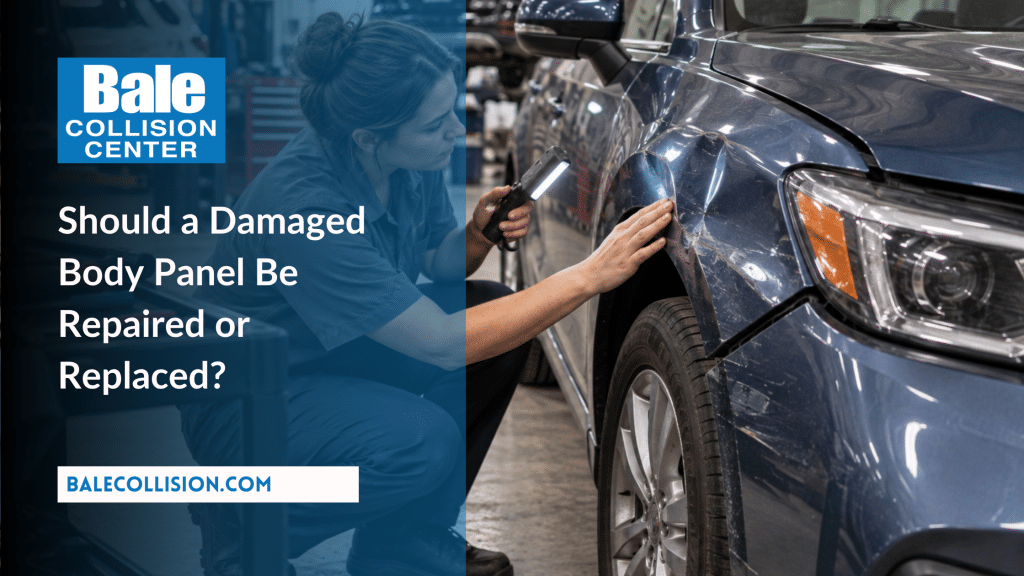
Whether a damaged body panel should be repaired or replaced depends on much more than the size of the dent.
Collision repair technicians may consider:
- Location of the damage
- Depth and severity of the dent
- Whether the metal is stretched
- Cracks, tears, or punctures
- Panel material
- Damage near edges, seams, or body lines
- Corrosion
- Previous repairs
- Accessibility from behind the panel
- Whether the panel is structural or cosmetic
- Nearby mounting points
- OEM repair procedures
- Whether repairing the panel can produce an appropriate, durable result
A shallow dent in an accessible steel panel may be repairable. A severely stretched, torn, corroded, or structurally compromised panel may require replacement. Aluminum, high-strength steels, and other modern materials can also have manufacturer-specific repair restrictions.
Replacement is not automatically better than repair, and repair is not always the less expensive or appropriate choice. The right decision is the one supported by the damage, material, repair procedures, and complete repair plan.
For professional damage evaluation in Little Rock, visit Bale Collision Center at 13101 Chenal Pkwy, Little Rock, AR 72211, United States. Bale provides auto body repair, collision repair, paintless dent repair, and auto paint and refinishing.
Introduction
After an accident, one of the first questions you may have about a damaged door, fender, hood, or quarter panel is:
Can this be repaired, or does the entire panel need to be replaced?
It sounds like a simple decision.
If the dent is small, repair it. If the dent is large, replace the panel.
Modern collision repair is rarely that straightforward.
Two dents that look almost identical from several feet away can require completely different repair methods.
One might be located in an easily accessible portion of a conventional steel fender. Another might cross a reinforced body line, involve stretched metal, or affect a panel made from a material with specific manufacturer repair limitations.
The decision can also depend on whether the damaged component is simply an exterior cosmetic panel or part of the vehicle’s structure.
That is why professional repair planning evaluates the complete damage rather than making the repair-versus-replace decision based on appearance alone.
What Does It Mean to Repair a Body Panel?
Repairing a panel means retaining the existing component and restoring the damaged area using an appropriate repair method.
Depending on the damage, conventional body repair may involve:
- Accessing the damaged area
- Reshaping the panel
- Correcting low or high areas
- Preparing the surface
- Using appropriate repair materials when necessary
- Applying primer
- Refinishing the panel
- Restoring corrosion protection where required
The exact process depends on the panel material and type of damage.
If the paint remains intact and the dent qualifies, paintless dent repair may provide another option.
What Does It Mean to Replace a Body Panel?
Panel replacement involves removing the damaged component and installing another component according to the applicable repair procedures.
The complexity depends heavily on the panel.
Replacing a bolt-on fender can be very different from replacing a welded quarter panel.
A replacement may involve:
- Removing adjacent components
- Removing damaged attachment points
- Preparing the replacement panel
- Welding, riveting, bonding, or using another specified joining method
- Restoring corrosion protection
- Refinishing
- Reassembling the vehicle
Replacement therefore does not necessarily mean the repair is simpler.
Which Body Panels Can Commonly Be Repaired?
Many types of exterior panels can potentially be repaired when the damage and manufacturer procedures allow it.
Examples include:
- Doors
- Fenders
- Hoods
- Quarter panels
- Roof panels
- Deck lids
- Liftgates
But the panel name alone does not determine repairability.
A repairable dent in one door does not mean every damaged door can be repaired.
Technicians need to evaluate the specific damage.
What Factors Determine Whether a Panel Can Be Repaired?
A professional repair-versus-replace decision may consider several factors together.
Damage severity
A shallow dent may be easier to restore than a deep impact that significantly changes the panel’s shape.
Damage location
Damage in the center of a broad panel may behave differently from damage near:
- Edge
- Seam
- Body line
- Reinforcement
- Mounting point
Panel material
Steel, high-strength steel, aluminum, and other materials can have different repair characteristics.
Metal stretch
If collision forces significantly stretch the metal, restoring the original contour can become more difficult.
Accessibility
Some repair techniques require access behind the damaged area.
OEM requirements
The vehicle manufacturer may establish limitations for certain components or materials.
The final decision should consider all of these factors rather than relying on a single rule.
Does the Size of the Dent Determine Whether the Panel Should Be Replaced?
Not by itself.
Dent size matters, but it is only one part of the evaluation.
A relatively large, shallow dent in an accessible area might sometimes be repairable.
A much smaller dent could be more difficult if it:
- Is extremely deep
- Has sharply creased the metal
- Sits on a complex body line
- Damages an edge
- Involves a reinforced area
This is why the statement “large dent equals replacement” is too simplistic.
Technicians need to consider what happened to the material.
Why Does Dent Depth Matter?
A deep impact concentrates deformation into a smaller area.
This can:
- Stretch metal
- Create sharp creases
- Distort nearby contours
- Affect surrounding areas
A shallow dent often distributes deformation across a broader area.
The technician therefore evaluates the three-dimensional shape of the damage, not merely its width and height.
What Does It Mean When Metal Is Stretched?
Sheet metal changes shape when collision force pushes it beyond its original contour.
With enough deformation, the material can stretch.
Stretched metal may no longer fit naturally within the same area it occupied before the collision.
Technicians have methods for addressing certain stretched areas, but the extent and location of the stretch influence whether repair remains practical and appropriate.
Severe stretching can push the repair decision toward replacement.
Why Do Sharp Creases Make Panel Repair More Difficult?
A crease concentrates damage along a relatively narrow line.
Sharp creases can be more challenging because the material may be:
- Stretched
- Work-hardened
- Distorted along multiple contours
A crease through a complex body line can be particularly difficult.
However, the presence of a crease does not automatically mean the panel must be replaced.
The technician still needs to evaluate the complete condition.
Why Do Body Lines Matter?
Modern vehicle panels often include deliberate creases and contours that contribute to the vehicle’s design.
A dent that crosses a body line can distort:
- Shape
- Reflection
- Adjacent panel relationships
Restoring the panel requires recreating those contours accurately.
Damage in a flat or gently curved area may offer more repair flexibility than severe damage concentrated along a complex body line.
Does Damage Near a Panel Edge Matter?
Yes.
Panel edges can be more difficult to repair because they may contain:
- Folded metal
- Hem flanges
- Reinforcement
- Attachment points
For example, damage in the center of a door skin can present a different repair situation from damage directly along the door’s folded edge.
The technician needs to evaluate both the visible surface and how the panel is constructed underneath.
What Is a Hem Flange?
A hem flange is a folded edge used in the construction of certain panels.
You can find this type of construction around components such as:
- Doors
- Hoods
- Deck lids
Damage in these areas can affect more than the outer visible surface.
If an impact significantly distorts the hemmed edge or underlying structure, replacement may become more appropriate depending on the component and OEM procedures.
Does a Torn Body Panel Need to Be Replaced?
A tear or puncture generally creates a more complex repair decision than an ordinary dent.
Technicians need to consider:
- Material
- Tear location
- Length
- Surrounding deformation
- Component function
- Manufacturer procedures
Some damaged areas may have permitted repair procedures.
Others may require replacement.
A technician should not automatically weld every torn panel simply because the opening can physically be closed.
What About a Panel With Cracked Paint?
Cracked paint does not automatically mean the panel needs replacement.
It does mean the repair is unlikely to qualify for true paintless dent repair if the damaged finish cannot be preserved.
A conventional repair may involve:
- Restoring panel shape
- Preparing the damaged finish
- Priming
- Refinishing
The condition of the metal underneath still determines whether retaining the panel is appropriate.
Can a Rusted Panel Be Repaired?
Sometimes, but corrosion changes the evaluation.
Minor surface corrosion is very different from a panel that has:
- Deep rust
- Perforation
- Significant material loss
If corrosion has substantially weakened the panel, simply covering the area with filler and paint would not address the underlying deterioration.
The shop should determine how far the corrosion extends before recommending a repair.
Why Is Corrosion Protection Important After Panel Repair?
Factory vehicle bodies use corrosion-protection materials in many areas.
Collision repairs can disturb those protections through:
- Sanding
- Grinding
- Welding
- Cutting
- Panel replacement
Depending on the repair, technicians may need to restore materials such as:
- Primer
- Seam sealer
- Cavity wax
- Other protective coatings
I-CAR provides collision repair guidance addressing the restoration of corrosion protection after repairs.
External resource:
https://rts.i-car.com/13351.html
This is an important part of the repair even though much of it may not be visible when the vehicle is finished.
Can Paintless Dent Repair Save a Damaged Panel?
Yes, when the damage qualifies.
Paintless dent repair, commonly called PDR, reshapes certain dents without conventional refinishing.
It may be appropriate when:
- Paint remains intact
- Dent shape is suitable
- Panel material is appropriate
- Technician can access the damage
- Metal is not excessively stretched
- Structural damage is not involved
PDR can be particularly useful for:
- Door dings
- Minor dents
- Certain hail dents
Bale Collision Center offers paintless dent repair for qualifying damage.
Does Every Dent With Undamaged Paint Qualify for PDR?
No.
Intact paint is only one factor.
PDR may be limited by:
- Severe stretching
- Sharp crease
- Panel edge
- Poor access
- Previous body repair
- Panel construction
- Material
A technician should inspect the dent before determining whether PDR is appropriate.
Can a Previously Repaired Panel Be Repaired Again?
Potentially.
But previous repairs can change the situation.
A technician may discover:
- Body filler
- Previous welds
- Prior paintwork
- Previous corrosion
- Existing distortion
These conditions can affect which repair methods are appropriate.
For example, a panel containing previous filler may not behave the same way during paintless dent repair as a factory-original panel.
Why Does the Panel Material Matter?
Modern vehicles can use several materials throughout the body.
Depending on the vehicle, these may include:
- Mild steel
- High-strength steel
- Ultra-high-strength steel
- Aluminum
- Composites
- Plastics
Different materials have different properties.
They may respond differently to:
- Heat
- Straightening
- Welding
- Cutting
- Repair
This is one reason technicians should identify the material before choosing a repair method.
Can Aluminum Body Panels Be Repaired?
Some aluminum damage can be repaired.
However, aluminum behaves differently from conventional steel.
Aluminum repair can require:
- Specialized tools
- Material-specific techniques
- Contamination control
- Different repair considerations
Repairability depends on:
- Panel
- Damage
- Material
- Manufacturer procedures
The presence of aluminum does not automatically mean replacement, but technicians should not treat it exactly like conventional steel.
Why Can Aluminum Repairs Require Separate Tools?
Steel particles can contaminate aluminum repair surfaces and contribute to corrosion concerns.
Collision repair facilities performing aluminum work may therefore use:
- Dedicated tools
- Controlled work areas
- Material-specific procedures
The exact requirements depend on the repair and vehicle manufacturer.
What About High-Strength Steel?
Modern vehicles use high-strength steels to achieve combinations of:
- Strength
- Weight reduction
- Structural performance
Some of these steels have restrictions involving:
- Heat
- Straightening
- Sectioning
- Welding
A repair technique that is acceptable on one type of steel may not be appropriate on another.
Technicians should research the vehicle’s construction before deciding how a damaged component will be repaired.
Can Heat Be Used to Straighten Every Steel Panel?
No.
Heat can change the properties of certain modern steels.
Vehicle manufacturers may restrict or prohibit the use of heat on particular components.
This is particularly important when dealing with structural materials.
The correct procedure should be based on OEM repair information rather than assumptions from older repair methods.
Why Are OEM Repair Procedures Important?
The manufacturer knows:
- How the vehicle was constructed
- Which materials were used
- Where specific materials are located
- Which joining methods were used
- Which repair methods are permitted
OEM repair information may address questions such as:
- Can this component be repaired?
- Can it be straightened?
- Can heat be used?
- Can the component be sectioned?
- Where can it be sectioned?
- What joining method is required?
- What corrosion protection must be restored?
I-CAR’s OEM Technical Information Matrix helps collision professionals locate manufacturer-specific repair information.
External resource:
https://rts.i-car.com/oem-information/oem-technical-information-matrix.html
Is a Fender Different From a Quarter Panel?
Yes.
A front fender on many vehicles is a bolt-on exterior component.
A quarter panel is commonly integrated more extensively into the body and may be welded or otherwise permanently attached.
Replacing a bolt-on fender may involve:
- Removing fasteners
- Transferring components
- Aligning replacement panel
- Refinishing
Replacing a quarter panel can involve substantially more invasive operations.
This difference can influence the repair-versus-replace decision.
Should a Damaged Fender Be Repaired or Replaced?
It depends on the damage.
Repair may make sense when the fender has:
- Repairable dents
- Manageable creases
- Limited surface damage
- Intact mounting areas
Replacement may become more appropriate when there is:
- Severe deformation
- Extensive tearing
- Major edge damage
- Compromised mounting points
- Damage that makes repair impractical
Because many fenders are bolt-on components, replacement can sometimes be more efficient than spending extensive labor restoring a severely damaged one.
But that decision should be made case by case.
Should a Damaged Door Be Repaired or Replaced?
Again, it depends.
A door contains more than the visible outer skin.
Depending on the vehicle, it can include:
- Outer panel
- Inner structure
- Reinforcement
- Side-impact components
- Window regulator
- Wiring
- Locks
- Sensors
A shallow outer-panel dent may be repairable.
A severe side impact that damages the inner door structure can create a very different repair decision.
Technicians need to inspect the complete door assembly.
Can Just the Door Skin Be Replaced?
On some vehicles, a door outer panel or “door skin” may be available, and replacement may be permitted.
This allows technicians to replace the damaged exterior skin while retaining appropriate portions of the original door assembly.
However, the procedure is vehicle-specific.
Technicians should verify:
- Parts availability
- OEM procedure
- Condition of inner door
- Hem flange requirements
before choosing that approach.
Should a Damaged Hood Be Repaired or Replaced?
A hood may be repairable when damage is limited, and the inner structure remains appropriate for repair.
Replacement may become more likely when:
- Damage is severe
- Outer and inner panels are distorted
- Hemmed edges are compromised
- Latch area is affected
- Manufacturer procedures limit repair
Hood operation also matters.
After repair, the hood needs to:
- Align correctly
- Open properly
- Close properly
- Latch securely
What About a Damaged Trunk Lid or Liftgate?
The same general principles apply.
Technicians may evaluate:
- Outer-panel damage
- Inner-panel damage
- Hinges
- Latch
- Glass
- Wiring
- Cameras
- Other electronics
A small dent in the exterior surface is very different from collision damage that distorts the entire closure.
Should a Damaged Quarter Panel Be Repaired?
Repair can sometimes be particularly valuable on a quarter panel because replacement can require extensive operations.
Depending on the vehicle, quarter-panel replacement can involve:
- Cutting
- Removing factory joining points
- Welding or other joining methods
- Refinishing
- Restoring seam sealer
- Restoring corrosion protection
If the original quarter panel can be appropriately repaired according to applicable procedures, retaining it may avoid unnecessary invasive replacement work.
However, severe damage can still make replacement necessary.
Why Isn’t Replacing a Panel Always Better?
New does not automatically mean better for every situation.
Replacing a welded body panel can require disturbing:
- Factory welds
- Seams
- Coatings
- Adjacent finishes
The replacement then needs to be installed according to the specified procedures, and appropriate protections restored.
If the original panel has repairable damage, retaining it can sometimes be an appropriate solution.
The goal is not to maximize the number of replacement parts.
The goal is to choose the correct repair method.
Why Isn’t Repairing the Original Panel Always Better?
Because some damage exceeds what should reasonably or technically be repaired.
Trying to save a severely damaged panel can require excessive:
- Straightening
- Filler
- Heat
- Labor
or procedures the manufacturer does not permit.
In those cases, replacement may provide the more appropriate repair path.
Neither “always repair” nor “always replace” is a good rule.
How Much Body Filler Is Too Much?
Body filler is a legitimate professional repair material when used appropriately as part of a proper repair process.
It is not intended to replace correct metalwork or conceal major unresolved deformation.
The underlying panel should first be repaired appropriately.
Technicians should follow the repair-material manufacturer’s procedures concerning:
- Surface preparation
- Application
- Thickness
- Curing
A thick mass of filler should not be used simply to avoid addressing severely damaged metal.
Does Panel Replacement Always Cost More?
No.
This surprises many vehicle owners.
The replacement part itself costs money, but repairing a severely damaged original panel can require substantial labor.
A repair estimate may need to compare:
Repair option
- Body labor
- Materials
- Refinishing
with:
Replacement option
- Replacement part
- Removal and installation
- Transfer operations
- Joining operations when applicable
- Refinishing
Depending on the panel and damage, either option can be more economical.
Why Does Labor Time Matter?
Collision repair estimates account for both:
- Parts
- Labor
If a relatively inexpensive bolt-on panel would require many hours of complex metal repair, replacement may make more sense.
Conversely, replacing a welded panel may require significantly more operations than repairing manageable damage in the original component.
This is why the lowest parts cost does not necessarily equal the lowest total repair cost.
Can Insurance Determine Whether a Panel Is Repaired or Replaced?
Insurance may be involved in reviewing the estimate and claim, but the repair decision should still account for:
- Actual damage
- OEM procedures
- Repairability
- Parts availability
- Required operations
If there is disagreement about an operation, the collision repair facility may document the condition and supporting repair information.
The goal should be an appropriate repair plan for the specific vehicle.
What Is a Repair Supplement?
Sometimes the complete condition of a panel or surrounding components cannot be determined during the first exterior inspection.
After disassembly, technicians might discover:
- Hidden tear
- Damaged reinforcement
- Broken mounting point
- Additional panel distortion
The estimate may then need to be updated.
This additional documentation is commonly called a supplement.
It allows newly discovered repair requirements to be added to the repair plan.
Can Hidden Damage Change a Repair Decision?
Absolutely.
Imagine that a damaged door initially appears repairable.
After disassembly, technicians discover that the impact also damaged an inner reinforcement.
The repair plan may change.
Likewise, a bumper or fender may conceal damage to mounting components that affects the overall repair.
Professional collision repair therefore involves evaluating both visible and hidden damage before finalizing major repair decisions.
What Is Direct and Indirect Collision Damage?
Direct damage occurs at the location where the vehicle was struck.
Indirect damage develops when collision forces travel beyond that point.
For example, a direct impact to a front fender may also change:
- Hood gap
- Door gap
- Mounting area
Those surrounding changes can indicate indirect damage.
I-CAR provides repair guidance on identifying direct and indirect collision damage.
External resource:
https://rts.i-car.com/crn-1406.html
Technicians should consider the complete damage pattern rather than evaluating one dent in isolation.
Does Structural Damage Change the Repair Decision?
Yes.
There is an important distinction between an exterior cosmetic panel and a structural component.
Structural repair decisions can have specific manufacturer requirements involving:
- Straightening
- Replacement
- Sectioning
- Welding
- Riveting
- Adhesive
- Heat
Technicians should not assume that a repair method appropriate for an exterior fender is also appropriate for a structural rail, pillar, or reinforcement.
What Is Sectioning?
Sectioning involves replacing only a specified portion of a component rather than replacing the complete component.
Sectioning is not automatically permitted.
Manufacturers may specify:
- Whether sectioning is allowed
- Exact sectioning locations
- Joining procedures
If no appropriate procedure permits sectioning, technicians should not invent an arbitrary cut location merely to reduce the amount of replacement work.
OEM repair information should guide the decision.
Why Do Joining Methods Matter During Panel Replacement?
Modern vehicle bodies can use several joining technologies.
Depending on the component, replacement may involve:
- Resistance spot welding
- MIG/MAG welding
- MIG brazing
- Rivets
- Structural adhesive
- Combinations of methods
The correct method depends on the vehicle and component.
Installing a replacement panel is therefore not simply a matter of making it physically stay in place.
The specified joining procedure matters.
Can Panel Replacement Affect Nearby Paint?
Yes.
Replacement can require refinishing the new panel and, depending on the color and repair plan, possibly blending adjacent areas.
For example, replacing a front fender may require technicians to evaluate color transition relative to:
- Hood
- Front door
Professional auto paint and refinishing helps the replacement panel visually integrate with the surrounding vehicle.
Why Is Accurate Paint Matching Important After Panel Repair?
Whether a panel is repaired or replaced, the finished color needs to work with the surrounding vehicle.
Technicians may consider:
- Paint code
- Color variants
- Existing finish
- Metallic orientation
- Pearl effects
- Previous refinishing
A technically sound panel repair can still stand out if the color match is poor.
Refinishing is therefore an important part of the overall body repair.
Can Panel Repair Affect ADAS?
Potentially, depending on the panel and vehicle.
Modern vehicles can have:
- Radar
- Cameras
- Parking sensors
- Wiring
associated with various body areas.
For example, bumper repair or replacement may affect sensor-related areas.
Some repairs can also require removal of components associated with ADAS.
Technicians should identify the vehicle’s equipment and check OEM requirements before determining whether diagnostic or calibration procedures apply.
Does Replacing a Body Panel Automatically Require ADAS Calibration?
No.
Panel replacement by itself does not mean every vehicle requires calibration.
The requirement depends on:
- Vehicle
- Panel
- Sensor location
- Components removed
- Components replaced
- Repair operations
- OEM procedures
Bale Collision Center provides ADAS calibration services when calibration is required as part of the repair.
NHTSA explains that modern driver-assistance systems can rely on cameras, radar, and other sensors positioned around the vehicle.
External resource:
https://www.nhtsa.gov/vehicle-safety/driver-assistance-technologies
How Long Does Body Panel Repair Take?
There is no universal timeframe.
Repair duration depends on:
- Panel
- Damage severity
- Material
- Repair method
- Refinishing
- Parts availability
- Hidden damage
- Additional collision operations
A small repairable dent may take substantially less time than replacing a welded quarter panel.
The complete repair plan provides a better timeline than the visible dent alone.
Is Repairing a Panel Faster Than Replacing It?
Not always.
A minor dent repair may clearly be faster than replacing the panel.
But severely damaged metal can require substantial repair labor.
Meanwhile, a bolt-on replacement panel may be comparatively straightforward.
For welded components, replacement can require much more extensive work.
The answer depends on the particular component.
Is Replacing a Panel Better for Resale Value?
Not automatically.
Vehicle value can depend on many factors, including:
- Collision history
- Repair quality
- Overall condition
- Vehicle age
- Market
The goal of collision repair should be to perform the appropriate repair, not simply maximize or minimize the number of replacement panels.
A properly executed repair and a properly executed replacement can both be appropriate depending on the damage.
What Questions Should You Ask the Auto Body Shop?
When a shop recommends repairing or replacing a panel, consider asking:
- Why is repair appropriate?
- Why is replacement necessary?
- What material is the panel made from?
- Is the metal stretched?
- Are the panel edges or mounting points damaged?
- Is there damage underneath?
- Does the manufacturer permit the proposed repair?
- Are there structural components involved?
- What corrosion protection will be restored?
- Will adjacent panels require refinishing?
- Are any sensors or ADAS components affected?
A good explanation should be based on the condition of your vehicle rather than a generic rule.
How Can You Tell if a Panel Repair Was Done Correctly?
After repair, inspect:
- Panel contour
- Body lines
- Panel gaps
- Paint match
- Finish texture
- Adjacent trim
Operate nearby:
- Doors
- Hood
- Trunk
- Liftgate
The repaired area should visually integrate with the rest of the vehicle, and the surrounding components should function normally.
If something looks or operates differently after repair, bring it to the repair facility’s attention.
What Should You Check After Panel Replacement?
Look for:
- Consistent panel gaps
- Proper alignment
- Secure trim
- Appropriate paint match
- Normal operation of doors or closures
- No unexpected warning lights
You can also ask the repair facility to explain:
- How the panel was attached
- Which OEM procedures were applied
- Whether corrosion protection was restored
- Whether diagnostic or calibration procedures were required
You do not need to become a collision repair expert.
You simply need enough information to understand what was done to your vehicle.
Why Is the Cheapest Repair Option Not Always the Best Choice?
Repair-versus-replace decisions should not be made solely by selecting whichever line on an estimate has the smaller number.
The lowest-cost approach might not account for:
- Full damage
- Required labor
- Manufacturer procedures
- Material limitations
- Related operations
Likewise, the most expensive approach is not automatically better.
The appropriate option is the one that addresses the damage using applicable repair procedures without unnecessary work.
Frequently Asked Questions
Is it better to repair or replace a damaged body panel?
Neither option is universally better. The appropriate choice depends on the damage severity, location, material, metal stretch, accessibility, underlying damage, and applicable OEM repair procedures.
How damaged can a panel be before it needs replacement?
There is no universal dent-size limit. Severe stretching, tearing, compromised edges or mounting areas, structural involvement, and manufacturer restrictions can all influence whether replacement is necessary.
Can a dented fender be repaired instead of replaced?
Often, yes, when the damage is suitable for repair. A severely distorted, torn, or compromised fender may be more appropriately replaced.
Can a dented door be repaired?
Many door dents can be repaired, but technicians need to determine whether the damage is limited to the outer panel or also involves the inner structure, reinforcement, edges, or mounting areas.
Can paintless dent repair prevent panel replacement?
For qualifying dents, PDR may allow technicians to retain the original panel and paint. However, not every dent qualifies for paintless dent repair.
Is replacing a body panel always more expensive?
No. A severely damaged panel can require enough repair labor that replacement becomes the more practical option. Conversely, replacing a welded panel can involve significantly more work than repairing manageable damage.
Does replacing a panel automatically require ADAS calibration?
No. Calibration requirements depend on the vehicle, sensor location, components removed or replaced, repair operations, and OEM procedures.
Where can I have a damaged body panel evaluated in Chenal?
Bale Collision Center provides auto body and collision repair at 13101 Chenal Pkwy, Little Rock, AR 72211, United States.
Get the Right Body Panel Repair in Chenal, Little Rock
Deciding whether to repair or replace a damaged body panel should not come down to one simple rule.
A technician needs to evaluate:
- How severely the panel is damaged
- Where the damage occurred
- Whether the material is stretched, torn, or compromised
- What material the panel is made from
- Whether the damage extends underneath the visible surface
- Whether the panel is structural
- What repair methods the vehicle manufacturer permits
- How repair and replacement compare within the complete repair plan
Sometimes preserving the original panel is the appropriate solution.
Sometimes replacement is the better repair.
And for qualifying minor dents, paintless dent repair may allow the original panel and factory finish to remain intact.
What matters is choosing the repair method based on the specific vehicle and actual damage, rather than assuming every dent should be repaired or every damaged panel should be replaced.
If your vehicle has a damaged fender, door, hood, quarter panel, or other body panel, visit Bale Collision Center at 13101 Chenal Pkwy, Little Rock, AR 72211, United States.
Bale Collision Center provides auto body repair, collision repair, paintless dent repair, and auto paint and refinishing for Little Rock drivers. When applicable to the repair, ADAS services are also available based on vehicle-specific requirements.
Visit the Bale Collision Center Chenal location or contact Bale Collision Center to have the damage professionally evaluated.

