
Modern vehicles are engineered with precise measurements and tolerances that affect everything from how your doors close to how your safety systems function. Digital measuring systems have transformed the auto body repair industry by providing the accuracy needed to restore vehicles to factory specifications.
At Bale Collision Center (Downtown), our technicians use advanced digital measuring technology to verify that every structural repair meets manufacturer standards. This technology allows us to detect frame misalignments that are invisible to the naked eye and correct them with millimeter precision. For vehicle owners in Downtown Little Rock seeking professional collision repair services, understanding how digital measuring systems work can help you make informed decisions about where to trust your vehicle after an accident.
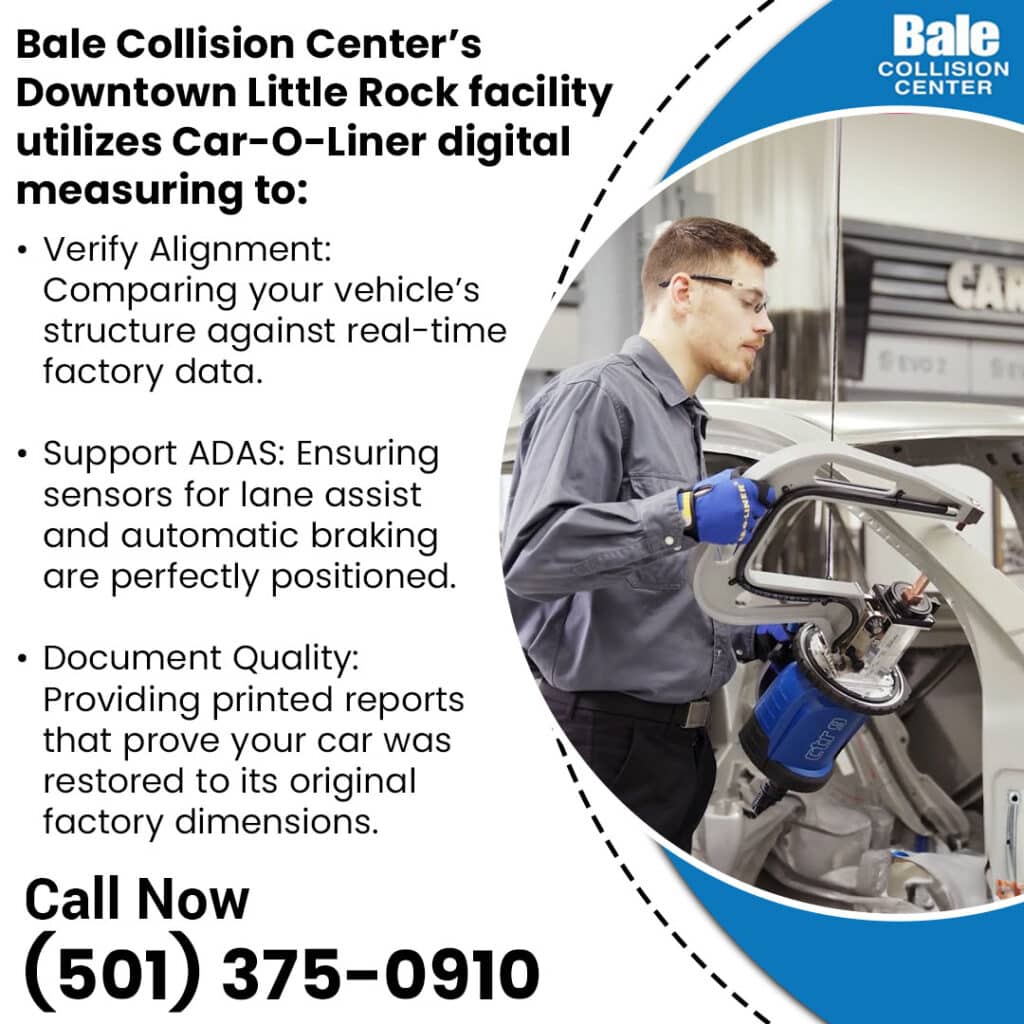
Digital Measuring Systems in Auto Body Repair
Digital measuring systems are computerized tools that assess a vehicle’s structural dimensions and compare them to factory specifications. These systems use laser technology, ultrasonic sensors, or electronic measuring devices to capture precise measurements of key structural points throughout your vehicle’s frame and body.
Unlike traditional measuring methods that relied on tape measures and visual alignment, digital systems provide objective data about your vehicle’s structure. Modern vehicles are engineered with tighter structural tolerances than older models, meaning precise measurement tools help technicians restore factory‑specified dimensions more reliably than traditional, manual methods.
The technology works by measuring fixed reference points on your vehicle’s underbody and structure, then comparing these measurements to a database containing specifications for thousands of vehicle makes and models. This comparison reveals exactly where damage has occurred and how far the structure has deviated from its original form.
Importance of Frame Accuracy After a Collision
Your vehicle’s frame serves as its foundation, supporting all other components and systems. Even small misalignments caused by accidents can create problems that affect your vehicle’s performance and safety.
Impact of Misalignment on Vehicle Performance
Frame misalignment causes uneven tire wear, pulling while driving, and steering irregularities because wheels no longer sit at the correct angles relative to each other. You may notice your vehicle drifting to one side or steering that feels different than before the accident. These symptoms indicate that the frame hasn’t been properly restored to its original geometry.
More concerning is how misalignment affects crash protection. Crumple zones in modern vehicles are designed to absorb impact energy in specific ways during accidents. When the frame is misaligned, these crumple zones may not function as intended, possibly compromising your protection in a future collision.
Proper structural restoration is critical for maintaining crashworthiness in repaired vehicles. The frame must return to its exact factory dimensions to maintain the engineered safety features that protect you and your passengers.
Limitations of Visual Inspection Methods
Traditional repair methods relied heavily on visual inspection and manual measurements. While experienced technicians can identify obvious frame damage, many structural problems are not visible without precise measurement tools.
Frame rails may be twisted or shortened by amounts too small to see but large enough to affect vehicle performance and safety. A frame rail that appears straight to the eye may be off by several millimeters, which is enough to cause handling problems and compromise safety systems.
Digital measuring systems remove the guesswork by providing objective data about your vehicle’s structure. This technology allows an accident repair shop to identify damage that might otherwise go undetected and verify that repairs have restored the structure to factory specifications.
Advantages of Digital Measurement Technology
Digital measuring systems provide several benefits over traditional measuring methods, improving both the accuracy and efficiency of collision repair services.
Accurate Damage Identification
Digital systems identify hidden structural damage, frame twist, and subtle misalignments that visual inspection cannot detect. This complete damage assessment means repairs address all problems, not just visible damage.
For complex collision damage affecting multiple structural areas, digital measuring provides a view of how different damaged areas relate to each other. This information helps technicians plan repair strategies that address all damage systematically.
Hidden damage often exists in areas that appear undamaged on the surface. Floor pans may be pushed up, frame rails may be shortened, and structural supports may be bent without any visible exterior signs. Digital measuring reveals all these issues before repairs begin.
Quality Verification After Repairs
After completing structural repairs, digital measuring systems verify that the work meets factory specifications. This verification process provides objective proof that your vehicle’s structure has been properly restored.
Many insurance companies appreciate clear measurement documentation when reviewing structural repairs. Shops equipped with digital measuring tools can often provide more comprehensive repair records that support insurer review and transparency. These reports demonstrate that repairs have been performed correctly and provide a record of structural restoration for your vehicle’s history. This documentation can be valuable if you ever sell the vehicle, as it proves proper collision repair methods were used.
Time Efficiency in the Repair Process
While digital measuring systems represent an investment in technology, they actually speed up the repair process by reducing guesswork and rework. Traditional measuring methods often required trial-and-error adjustments, with technicians making corrections and then rechecking measurements repeatedly.
Digital systems provide continuous feedback, allowing technicians to achieve accurate results faster. The time saved during measurement and verification helps get your vehicle back to you sooner without sacrificing quality or accuracy.
Critical Applications for Digital Measuring
Certain types of collision damage make digital measuring systems particularly important for proper repairs.
Unibody Vehicle Structural Repairs
Most modern passenger vehicles use unibody construction, where the frame and body are integrated into a single structure rather than separate components. Unibody vehicles are more susceptible to structural damage in collisions because impact forces are distributed throughout the vehicle.
Digital measuring is critical for unibody repairs because:
- Multiple structural points must be verified to maintain the vehicle’s designed strength and crash protection, and the interconnected nature of unibody structures means damage in one area often affects measurements in other areas.
- Traditional body-on-frame construction, found mainly in trucks and some SUVs, separates the body from the frame, while unibody construction eliminates this separation, creating a lighter, more fuel-efficient structure that requires different repair approaches and more precise measurements.
Side-Impact and Rollover Damage Assessment
Side-impact collisions and rollovers can cause complex structural damage that affects multiple planes of the vehicle’s structure. These collisions may twist or bend the frame in ways that are difficult to assess without three-dimensional measurement capability.
Digital measuring systems excel at identifying the full extent of this damage by:
- Measuring in multiple directions simultaneously, enabling proper repair of complex structural damage that affects width, length, and height dimensions.
- Identifying the “banana” effect, where the vehicle’s structure curves from the point of impact, helping technicians understand the complete three-dimensional nature of the damage that requires correction in multiple directions.
High-Speed Collision Repairs
High-speed collisions generate forces that can damage structural areas far from the point of impact. The energy transferred through the vehicle’s structure may bend or twist frame rails, floor pans, and structural supports in ways that aren’t immediately obvious.
Digital measuring identifies all areas affected by these forces by:
- Verifying that repairs address all structural damage rather than just visible problems, which is particularly important for maintaining crash protection in high-speed collision repairs.
- Revealing how forces involved in high-speed impacts can travel through the entire vehicle structure, identifying damage to rear suspension mounting points or floor pan areas that may result from front-end impacts.
These complex damage scenarios require equipment and expertise that not all facilities possess. When searching for collision repair near you, verify that the shop has digital measuring capabilities to handle these challenging repair situations properly.
Digital Measuring and Vehicle Safety Systems
Today’s vehicles employ advanced safety features that depend on precise structural alignment to function properly. Digital measuring plays an important role in maintaining these systems after collision repair services.
ADAS Mounting Point Accuracy
Advanced Driver Assistance Systems (ADAS) use cameras, radar sensors, and other components mounted at specific locations that must be positioned within 1-2 millimeters of factory specifications. These mounting points must be positioned accurately for the systems to work correctly.
Digital measuring systems verify that structural repairs have maintained the proper positioning of ADAS mounting points. Even small misalignments can affect sensor operation, potentially causing safety features to malfunction or provide inaccurate warnings.
ADAS features include adaptive cruise control, lane departure warning, automatic emergency braking, and blind spot monitoring. These systems depend on sensors that must point in precise directions to function correctly. If the structure holding these sensors is misaligned, the sensors cannot work as designed.
Airbag Sensor Positioning Requirements
Modern vehicles have multiple airbag sensors mounted throughout the structure. These sensors must be positioned correctly to detect collisions and deploy airbags at the right time.
Structural misalignment can affect sensor positioning, potentially delaying or preventing proper airbag deployment. Our technicians use digital measuring to verify that structural repairs maintain proper positioning of all safety-critical mounting points, including airbag sensors.
Airbag systems are calibrated to deploy based on impact severity and direction. Sensors mounted in the front, sides, and rear of the vehicle must be properly positioned to accurately detect collision forces and trigger the appropriate airbags at the correct time.
Selecting a Qualified Collision Repair Shop
When choosing where to take your vehicle for collision repair near you, the shop’s measuring capabilities should be an important consideration.
Equipment and Technology Investment
Ask whether the shop uses digital measuring systems for structural verification, as this indicates commitment to quality repairs.
Accident repair shops that invest in advanced measuring technology demonstrate dedication to proper repair procedures. This equipment represents a substantial investment that many facilities avoid, but it’s necessary for accurate modern vehicle repairs.
Not all collision repair facilities have digital measuring systems. Some shops continue to use older measuring methods or skip structural measurement entirely. When selecting an accident repair shop, ask specifically about their measuring capabilities.
Technician Certification and Training
Digital measuring systems require trained operators who understand how to interpret measurement data and use it to guide repairs. Look for shops with I-CAR-certified technicians who have received the training in structural measurement and repair.
I-CAR (Inter-Industry Conference on Auto Collision Repair) provides standardized training and certification for collision repair professionals. Platinum-level individual certification represents the highest level of training and demonstrates expertise in modern repair techniques, including digital measurement and structural repair.
Documentation and Reporting Standards
Quality shops provide measurement reports showing dimensions taken before and after repairs, proving structural restoration to factory specifications. This documentation becomes part of your vehicle’s permanent service history and can be valuable for future reference.
These reports typically include diagrams showing all measurement points, the factory specifications for each point, the as-damaged measurements, and the final post-repair measurements. This documentation proves that repairs were completed correctly and that the vehicle’s structure has been restored to factory specifications.
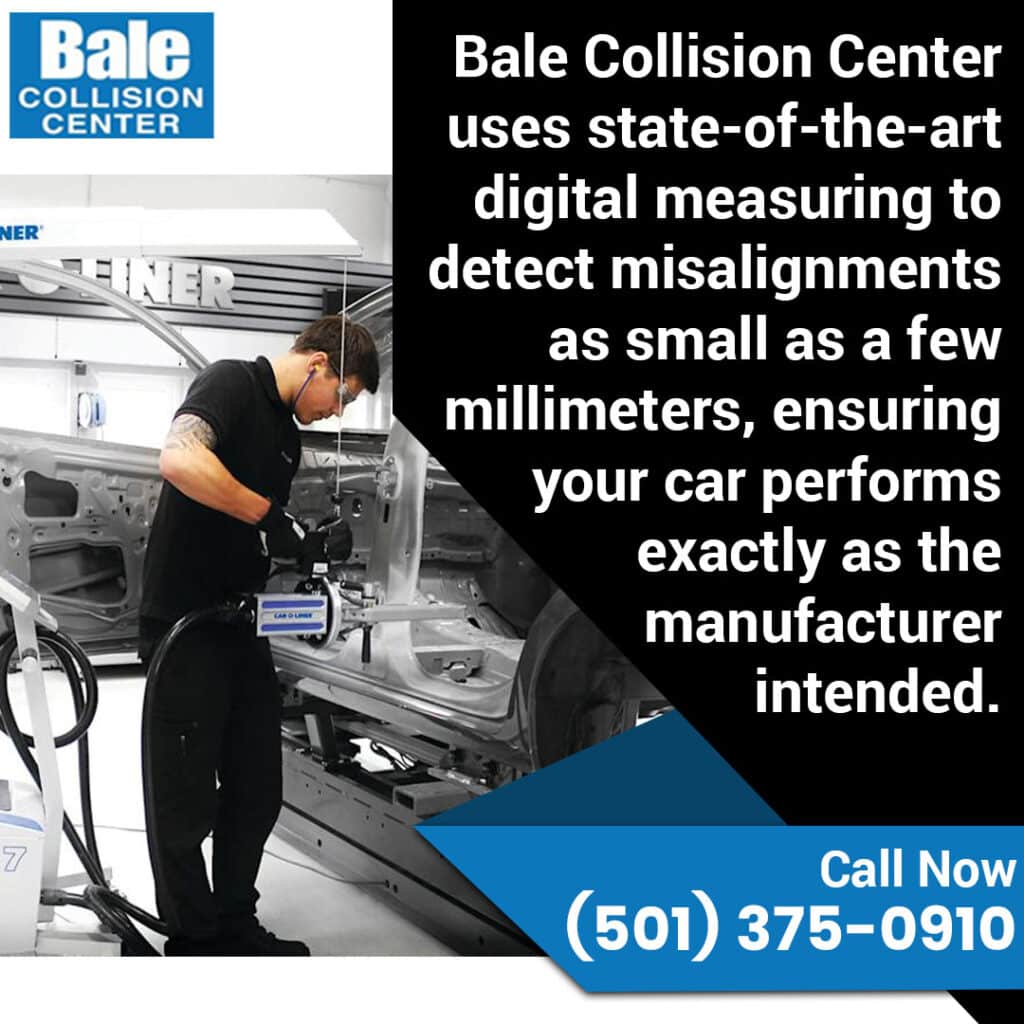
Bale Collision Center’s Commitment to Precision Collision Repair in Downtown Little Rock
Since 1952, we have invested in the technology and training needed to deliver accurate collision repair. Our facility uses advanced digital measuring systems combined with Car-O-Liner frame straightening equipment to restore vehicles to factory specifications.
Our I-CAR Gold Class certification and our technicians’ I-CAR Platinum certifications reflect our commitment to proper repair procedures. At Bale Collision Center, we understand that accurate structural repairs are fundamental to vehicle safety, and we use digital measuring technology to verify every structural repair we perform.
We work with all major insurance companies and provide the detailed documentation they require to verify repair quality. Our team manages the insurance claim process while keeping you informed about your vehicle’s repair progress with regular updates.
At Bale Collision Center, we maintain the equipment and expertise needed to handle even the most complex structural collision repair in Downtown Little Rock. From minor frame straightening to complete unibody restoration, we use digital measuring at every stage to verify accuracy and maintain quality.
Professional Structural Repair Services
Accurate collision repair requires precise measurement and verification. Digital measuring systems provide the accuracy needed to restore your vehicle’s structure to factory specifications, maintaining safety and performance after collision damage.
When you need collision repair in Downtown Little Rock, choose a shop that uses advanced measuring technology to verify repair quality. Contact Bale Collision Center at (501) 375-0910 or email bccdowntown@baleautomotive.com to schedule an assessment of your vehicle. Our certified technicians use digital measuring systems to deliver accurate collision repair near you that restores your vehicle’s safety and performance. Bale Collision Center serves Downtown Little Rock and nearby areas with the expertise and technology you need for proper structural repairs.