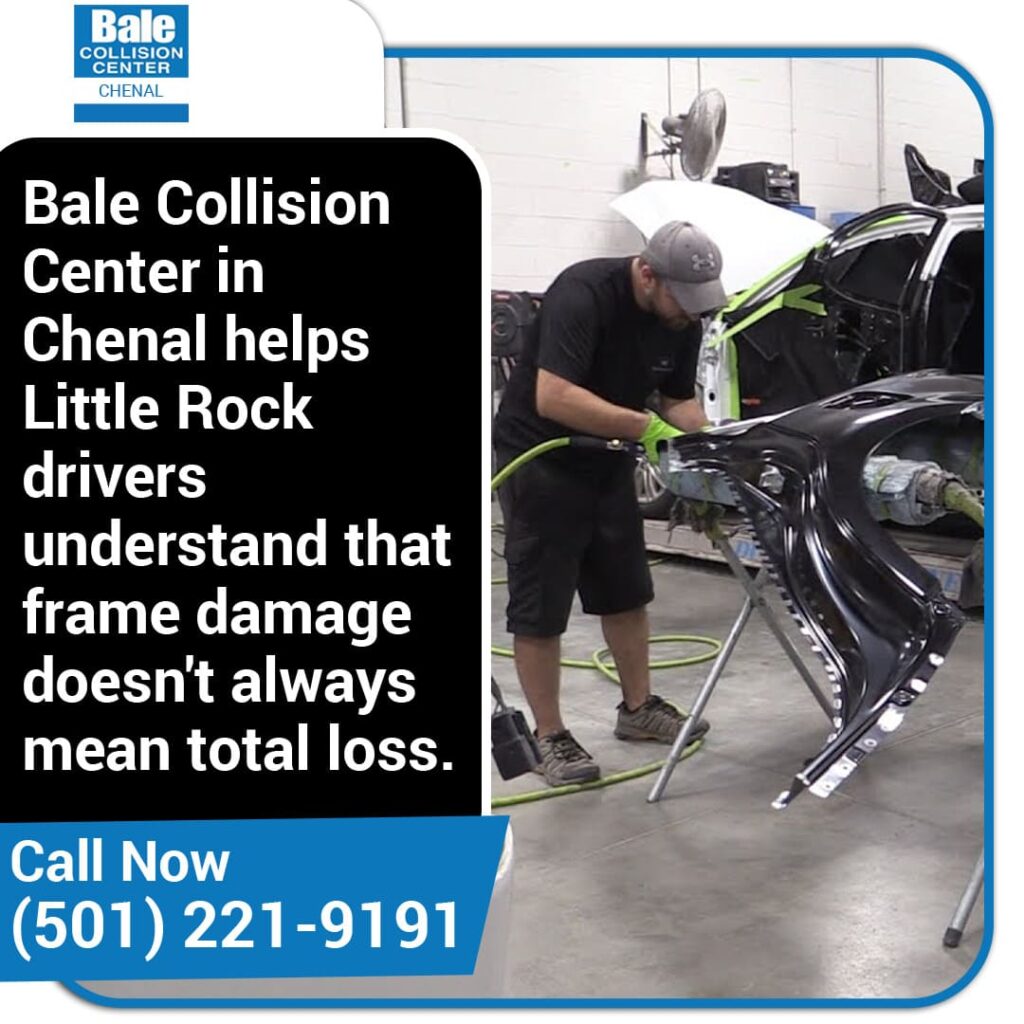
When drivers hear “frame damage” after a collision, many assume their vehicle is totaled or unsafe. This reaction stems from misconceptions about structural damage and repair capabilities. Frame damage varies widely in severity, and modern collision repair technology can restore many vehicles to manufacturer safety standards.
At Bale Collision Center (Chenal) in Little Rock, AR, we use precision measuring equipment and follow manufacturer-approved procedures to determine what can be repaired and how to restore structural integrity. Understanding what frame damage actually means helps drivers make informed decisions rather than assuming the worst.
Understanding Vehicle Frame Construction
Unibody vs. Body-on-Frame Design
Modern vehicles use two main structural designs that determine how they absorb impact forces. Unibody construction means the frame and body are built as one welded piece. This type of construction is common in most cars and crossovers. Body-on-frame design has a separate frame with the body mounted on top, typically found in trucks and some SUVs.
Unibody vehicles spread crash forces throughout the entire structure through crumple zones and reinforced sections. Body-on-frame vehicles rely on heavy steel rails to support the vehicle and absorb impacts. Each design responds differently to collisions and requires specific approaches during auto collision repair.
Components That Make Up the Frame
The frame includes several connected parts that work together to provide structural support and crash protection. Frame rails run lengthwise under the vehicle, providing the main structural support. Cross members connect the rails and add strength. Suspension mounting points attach to the frame and must stay in precise positions.
In unibody vehicles, floor panels, rocker panels, and pillars form part of the structural framework. These include the vertical columns you see on the sides of your vehicle at the windshield, between the doors, and at the rear window, as well as the reinforced sections running along the bottom. These parts must maintain specific spacing and relationships to each other. When one section shifts or bends during a car collision, it affects connected areas throughout the structure.
Types and Severity of Frame Damage
Minor vs. Major Frame Compromise
Frame damage ranges from minor misalignment to severe structural bending, with repair approaches varying based on severity. Minor damage might include small bends in less critical areas or slight shifts in panel alignment. A low-speed parking lot collision could push a bumper support back slightly without affecting major structural parts.
Major damage involves bending of primary structural members, multiple impact points, or damage to critical safety zones. High-speed collisions or impacts from multiple directions typically cause more extensive structural problems. The collision repair process begins with measuring the entire structure to classify damage severity accurately.
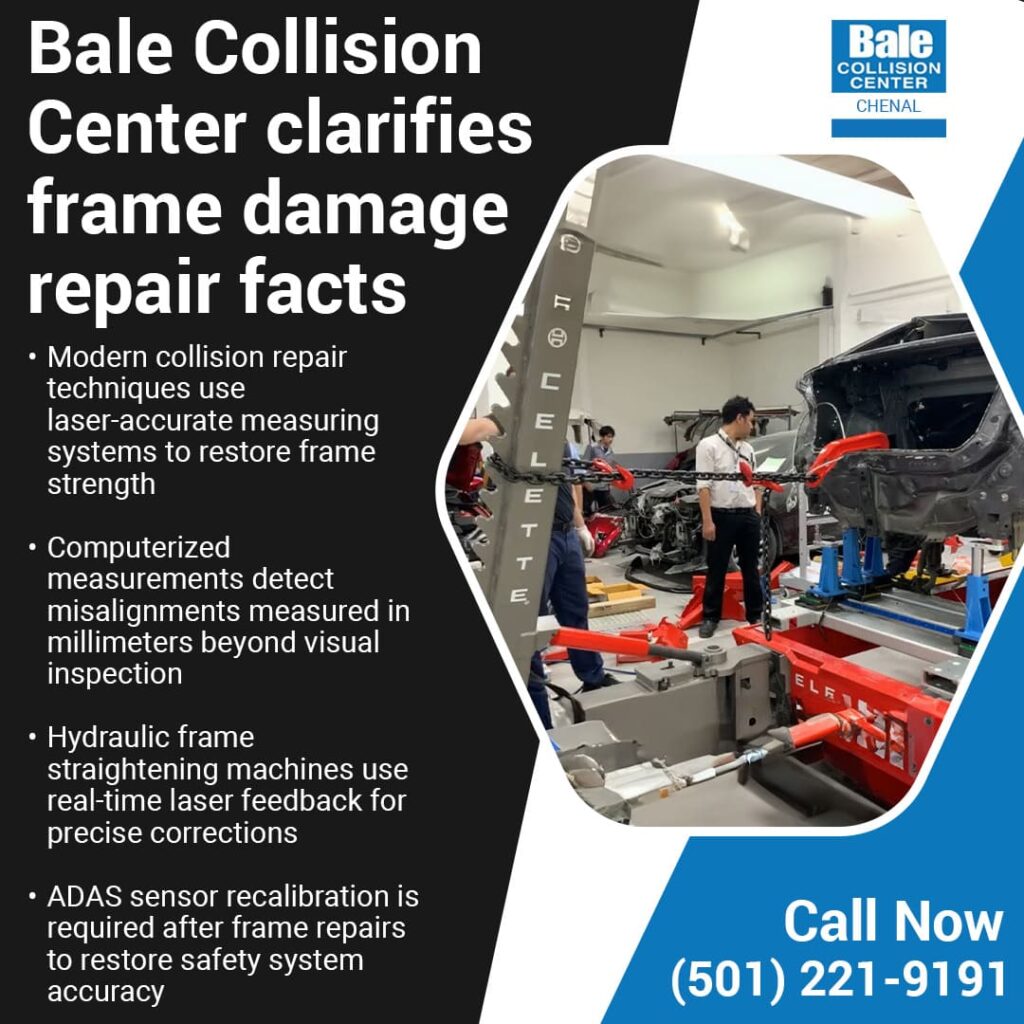
Technicians use computerized measuring systems to compare current dimensions against manufacturer specifications, identifying problems measured in millimeters. This precision allows accurate assessment of whether damage can be corrected through straightening or requires part replacement.
Common Misconceptions About Repairable Damage
Frame damage concerns many drivers because they’re unsure whether their vehicle can be safely repaired. Insurance companies actually base total loss decisions on repair feasibility and vehicle value, not frame damage alone. Vehicles with repairable frame damage can be restored to safe, functional condition when proper procedures are followed.
Another misconception is that repaired frames are always weaker than original structures. When certified collision repair technicians follow Original Equipment Manufacturer (OEM) procedures using proper equipment and techniques, repaired sections maintain original strength specifications. OEM procedures are manufacturer-published repair instructions that specify welding techniques, replacement requirements, and quality verification steps.
Modern car collision repair technology allows precise restoration that wasn’t possible decades ago, when frame damage carried a more negative perception. Equipment such as laser-guided measuring systems and computer-controlled straightening equipment delivers accuracy that older methods could not achieve.
When Frame Damage Results in Total Loss
Frame damage totals a vehicle when repair requirements exceed practical restoration limits or when multiple critical zones are compromised. Extensive damage to multiple structural areas, particularly in older vehicles, often reaches this threshold.
Damage to certain critical zones also affects repair decisions. Some ultra-high-strength steel sections cannot be repaired and must be replaced as complete assemblies. When multiple major parts require replacement and structural integrity is severely compromised, total loss becomes the practical outcome.
At Bale Collision Center, our technicians provide honest assessments when replacement makes more sense than repair. We evaluate the full scope of damage, considering both visible and hidden structural issues, to recommend the most appropriate course of action for auto collision repair in Chenal Parkway, Little Rock, AR.
Diagnosing Frame Damage
Visual Inspection Limitations
Visual inspection reveals obvious damage like bent metal and misaligned panels, but many frame issues remain hidden beneath exterior parts. A door that closes poorly or has uneven gaps between panels suggests underlying structural shifts.
Technicians look for indicators like paint cracking in unusual places, which signals metal movement. Wrinkled floor panels or rippled metal surfaces indicate energy absorption during impact. Uneven tire wear patterns can suggest suspension mounting points have shifted.
These visual cues guide more detailed investigation, but cannot provide the precision measurements needed for accurate planning. Professional collision centers use measurement systems that detect subtle misalignments invisible to the naked eye.
Computerized Measurement Systems
Laser-guided and computerized measuring systems detect frame misalignment down to the millimeter, far beyond what visual inspection can identify. Bale Collision Center uses Car-o-liner equipment, which creates three-dimensional measurements of the vehicle structure and compares them to manufacturer specifications stored in the system’s database.
The system identifies exactly where measurements fall outside acceptable tolerances and by how much. This data guides repair planning by showing technicians which areas need correction and the extent of adjustment required. A frame rail might be displaced from its original position in multiple directions.
Measurements are verified throughout the repair process and again after completion to document proper restoration. Modern measuring systems provide highly detailed dimensional data, allowing technicians to identify misalignments far beyond what a visual inspection can detect.
Pre-Scan and Post-Scan Diagnostics
Modern vehicles contain electronic sensors throughout the structure that must be tested after impacts to verify proper function. Pre-scan diagnostics identify which systems were affected by the collision and which sensors may have triggered error codes. Advanced Driver Assistance Systems (ADAS) include features like automatic emergency braking and lane departure warning that rely on sensors mounted to the vehicle structure.
After structural work, technicians perform both pre-scan and post-scan diagnostics to identify affected systems. ADAS components often require calibration following OEM procedures to restore proper sensor alignment. Crash sensors, airbag modules, and ADAS sensors are checked to confirm proper operation. This step confirms that the restored structure properly supports electronic safety systems integrated throughout the vehicle.
Our collision center uses advanced diagnostic equipment for system testing before and after repairs. This verification protects both the safety and functionality of modern vehicle technology.
Modern Repair Techniques That Save Vehicles
Precision Frame Straightening Equipment
Hydraulic frame machines are specialized equipment designed to restore bent structural components back to factory specifications. These machines apply controlled force from multiple directions at once, with laser measurements tracking every adjustment. The equipment can pull, push, and twist structural parts back to factory specifications without overstressing metal or creating weak points.
These machines work differently when compared to older methods that relied on heavy force and visual guesswork. Computer-controlled hydraulics adjust pressure continuously based on real-time measurements.
When operated by trained technicians using manufacturer-approved procedures and measuring systems, hydraulic frame machines help restore structural geometry toward the original specifications.
Section Replacement vs. Complete Frame Replacement
When frame sections sustain damage beyond straightening limits, certified technicians can remove and replace specific sections while keeping undamaged portions. This approach involves cutting out the damaged section and welding in a new factory part. Manufacturers provide repair procedures specifying cut locations, welding techniques, and reinforcement requirements for section replacements.
A damaged front frame rail might be cut at a manufacturer-specified location behind the damage zone. The new section is positioned precisely using measuring equipment, then welded using procedures that maintain structural strength. Complete frame replacement involves more extensive work but becomes necessary when damage affects multiple areas or critical zones.
The decision between section replacement and complete replacement depends on damage location, extent, and restoration feasibility. Section replacements provide equivalent safety and performance restoration when executed according to OEM specifications for certified collision repair.
OEM Procedures That Maintain Safety Standards
Vehicle manufacturers publish detailed repair procedures developed through crash testing and engineering that specify acceptable repair methods for different damage types. These procedures include information about straightening limits, required replacement parts, welding specifications, and quality verification steps.
Many OEM repair procedures note that certain ultra-high-strength steel components cannot be heat-straightened and require replacement when damaged beyond allowable tolerances. The procedures also specify welding methods with specific parameters for section replacements.
Following OEM procedures maintains the crash protection designed into the original structure. Generic car collision repair approaches that ignore manufacturer requirements can compromise safety even when the vehicle appears properly restored. Vehicles repaired using OEM procedures maintain original crash protection levels.
Materials and Welding Considerations
Different Steel Grades Throughout the Structure
Modern vehicles use multiple steel grades in different locations, with each type requiring specific repair approaches. Mild steel in less critical areas allows easier forming and repair. High-strength steel in structural zones provides increased protection with reduced weight. Ultra-high-strength steel in specific locations offers maximum crash resistance.
A typical modern sedan uses several different steel grades ranging from mild steel in the roof to ultra-high-strength steel in door impact beams. Each steel type responds differently to repair processes. Ultra-high-strength steel loses strength if heated beyond specified temperatures.
High-strength steel requires specific welding settings to maintain properties. At Bale Collision Center, our technicians identify steel grades using manufacturer documentation and adjust techniques accordingly for proper auto collision repair in Chenal Parkway, Little Rock, AR.
Why Proper Welding Matters for Frame Repairs
Welding quality directly affects structural strength and crash performance, with repair welds needing to replicate factory characteristics. Factory welds use specific techniques, materials, and controlled conditions to achieve the required strength. Repair welds must match these characteristics to maintain structural integrity.
Our technicians at Bale Collision Center use specialized Pro-Spot welding equipment designed to replicate factory welding conditions for different steel types. Proper welding creates joints that match or exceed original strength. Improper welding creates weak points that could fail during future impacts, potentially compromising safety and structural performance.
Impact on Safety Systems and Vehicle Function
How Frame Position Affects Airbag Deployment
Airbag systems rely on crash sensors mounted throughout the vehicle structure that must maintain precise positions for proper deployment timing. These sensors detect impact forces and signal the airbag control module when deployment is necessary. Sensor positioning and structure geometry affect how crash forces reach the sensors, influencing deployment timing and intensity.
Frame misalignment can alter sensor positions or change how forces transfer through the structure. A sensor that’s shifted even slightly might detect impacts differently than designed. A front impact sensor displaced rearward could delay airbag deployment timing.
According to National Highway Traffic Safety Administration research, proper airbag timing is critical for occupant protection. During certified collision repair, technicians verify sensor mounting positions and test system operation to confirm proper function after structural restoration.
ADAS Calibration Requirements After Framework
Advanced Driver Assistance Systems use cameras, radar, and sensors mounted to the vehicle structure that require precise positioning to function correctly. Frame damage and subsequent repair can shift mounting points enough to affect system accuracy.
After completing structural work, ADAS parts must be recalibrated to manufacturer specifications. This process involves either static calibration using targets positioned at specific distances and heights, or dynamic calibration through test drives on marked roadways.
Suspension Geometry and Handling Characteristics
The frame provides mounting points for suspension parts that must maintain specific positions relative to each other for proper handling and tire wear. Frame damage can shift these mounting points, affecting wheel alignment angles, steering response, and handling characteristics.
Suspension geometry includes measurements like caster angle, camber angle, and toe alignment. Frame damage that shifts suspension mounting points can alter these critical angles. Even when wheels can be aligned to specifications after frame damage, the vehicle may not handle properly if suspension mounting points remain out of position.
Proper frame restoration returns these mounting points to factory locations, allowing suspension geometry to function as designed. This restoration maintains handling characteristics and prevents premature tire wear caused by misaligned suspension parts.
Getting Expert Help for Frame Damage
Frame damage doesn’t automatically mean your vehicle is beyond repair. Modern diagnostic equipment, precision straightening systems, and manufacturer-approved procedures allow certified technicians to restore many vehicles to original safety standards. The key is thorough evaluation by qualified professionals using appropriate technology.
ng laser-guided measuring systems and diagnostic tools. We follow manufacturer procedures, use quality materials, and verify all work with precision measurements. Whether your vehicle needs a minor structural adjustment or extensive frame repair, we provide the expertise and equipment necessary for safe restoration.
Understanding what frame damage means and how modern repair technology addresses it helps you make informed decisions about your vehicle’s future. Don’t assume the worst when you hear “frame damage.” Contact us at (501) 221-9191 or bccwlr@baleautomotive.com for a professional evaluation of your frame damage. We provide trusted auto collision repair in Chenal Parkway, Little Rock, AR.
At Bale Collision Center, our I-CAR Platinum-certified technicians provide honest assessments of frame damage using