Your vehicle represents a substantial financial investment that extends beyond the initial purchase price. When collision damage occurs, the repair decisions you make will determine whether your car maintains its market value or experiences value depreciation. Repair quality, documentation practices, and adherence to manufacturer specifications create the actual difference in how much value your vehicle retains.
The relationship between repair workmanship and market value becomes apparent during pre-sale inspections, buyer negotiations, and dealer trade-in evaluations. Substandard work produces visible defects and hidden structural compromises that alert potential buyers to quality concerns. At Bale Collision Center (Chenal), we provide professional car body repair in Chenal, Little Rock, AR, following factory protocols that preserve vehicle integrity and create verifiable records. Our certified auto body repair approach focuses on protecting both your safety and your financial investment through proper procedures and documentation.
How Repair Quality Affects Market Value
The connection between workmanship standards and resale prices emerges through multiple evaluation factors that buyers and dealers examine during vehicle assessments.
Visible Quality Defects Reduce Buyer Confidence
Paint color mismatches become immediately apparent under natural lighting conditions. Shops that rush application processes or use incorrect paint formulations create color variations that range from subtle differences to obvious contrasts. These discrepancies signal to informed buyers that proper procedures were not followed.
Panel alignment irregularities reveal underlying structural problems. Doors that fail to close flush with the surrounding bodywork, hoods displaying uneven gaps, and bumpers sitting at incorrect heights indicate frame or mounting point issues. Buyers recognize these visual cues as evidence of inadequate workmanship extending beyond surface repairs.
Surface texture inconsistencies demonstrate poor preparation or application technique. Orange peel patterns, dust contamination, and areas where clear coat thickness varies create quality concerns that professional inspectors document. Auto body shop selection determines whether finished surfaces match factory specifications or display these telltale imperfections.
Hidden Damage Revealed During Professional Inspections
Pre-purchase mechanical evaluations uncover concealed problems that become negotiation leverage. Independent inspectors examine paint overspray on rubber seals and trim pieces, identify welding marks in trunk and door jamb areas, and measure structural dimensions against manufacturer tolerances.
Frame damage that received improper correction appears on alignment equipment and measuring systems. Even when vehicles track straight during test drives, measurements falling outside factory specifications indicate compromised structural integrity. This discovery typically terminates negotiations or results in substantial price reductions.
Corrosion developing beneath inadequate paint applications forecasts future deterioration. Inspectors search for paint bubbling, rust staining around repair zones, and oxidation on structural members. These findings suggest moisture infiltration during the repair process, creating progressive damage that will worsen over the vehicle’s remaining lifespan.
Documentation Deficiencies Create Buyer Hesitation
Absence of detailed repair records raises immediate questions about work quality. When sellers cannot provide documentation showing performed procedures, installed components, and followed manufacturer protocols, buyers assume worst-case scenarios. They incorporate potential hidden problems into offer calculations.
Missing calibration documentation for Advanced Driver Assistance Systems (ADAS) creates liability concerns. Modern vehicles require specific recalibration procedures following collision repairs to restore sensor functionality. Without records proving these calibrations occurred, buyers worry about safety system reliability.
Lack of Original Equipment Manufacturer (OEM) parts documentation suggests substitute components were installed. OEM parts typically maintain value better than aftermarket alternatives. When repair records fail to specify OEM usage, buyers question whether inferior parts were substituted.
Financial Consequences of Different Repair Approaches
Various auto body repair methodologies produce different financial outcomes when vehicle resale occurs.
Budget Repair Services and Long-Term Value Loss
Facilities offering exceptionally low prices typically employ methods that harm resale value. They might apply single-stage paint systems instead of proper base coat and clear coat applications, producing finishes that fade rapidly and fail to match adjacent panels. They frequently skip proper surface preparation steps, leading to adhesion failures that cause paint to separate within months of completion.
Inexpensive aftermarket components fit poorly and deteriorate faster than OEM alternatives. Aftermarket bumpers with incorrect mounting configurations create gaps that buyers immediately notice during inspections. Aftermarket lighting assemblies with inferior lens materials yellow prematurely and provide diminished illumination.
Omitted calibration procedures generate expensive problems for subsequent owners. When auto body shops bypass safety system recalibration after repairs, these systems may malfunction or operate incorrectly. Buyers discovering these issues during pre-purchase inspections either withdraw from negotiations or demand substantial reductions.
Certified Auto Body Repair and Value Preservation
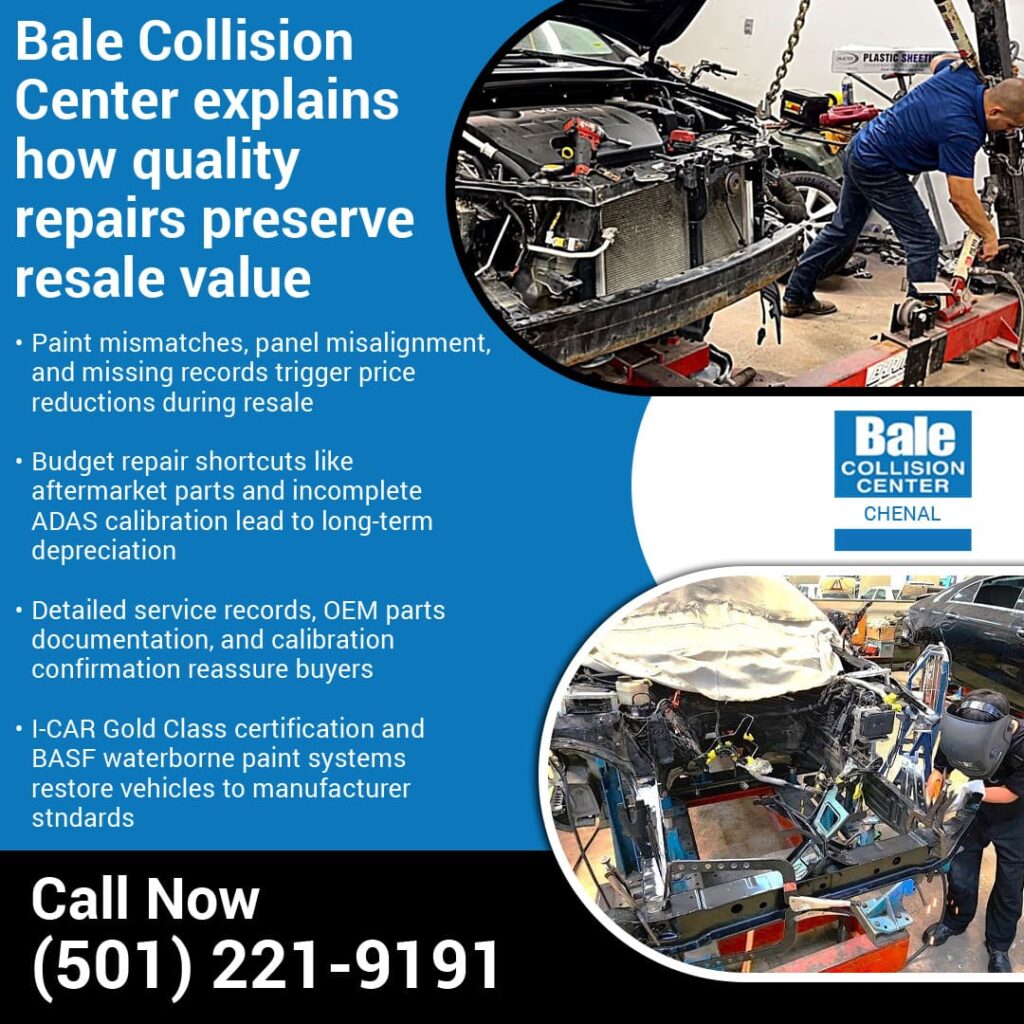
Certified facilities following manufacturer protocols maintain vehicle specifications that preserve resale value. They employ factory-approved welding techniques, proper structural adhesives, and correct replacement components that restore vehicles to original condition. This attention to procedural detail maintains safety ratings and structural integrity that support market value.
Complete documentation from certified auto body repairs reassures potential buyers about workmanship quality. Detailed records showing OEM parts installation, calibration completion, and manufacturer procedure compliance demonstrate that repairs met required standards. This documentation eliminates buyer uncertainty, supporting higher sale prices during negotiations.
Advanced paint-matching technology produces invisible repairs. Modern auto body services utilizing computerized color analysis and proper application techniques create finishes indistinguishable from factory paint. When repairs blend seamlessly with surrounding surfaces, buyers perceive a well-maintained vehicle rather than an accident history.
Vehicle History Reports and Their Market Impact
Carfax and AutoCheck reports follow vehicles permanently, affecting buyer decisions and dealer trade-in valuations throughout ownership cycles.
Accident Record Appearance and Classification
Collision incidents appear on reports when insurance claims are filed or police reports are generated. Even minor accidents requiring auto body services appear on vehicle history documentation if insurance was involved. These records follow vehicles through subsequent ownership transfers, affecting value at each transaction.
Severity classifications help buyers understand accident impact. Reports categorize damage as minor, moderate, or severe based on insurance claim amounts and police report descriptions. Severe damage classifications reduce resale value substantially, even when repairs are performed perfectly to manufacturer specifications.
Airbag deployment records indicate collision severity levels. Accidents involving airbag deployment appear as major incidents on vehicle history reports because they signal substantial impact forces. These records lower the resale value more than accidents without airbag deployment, regardless of repair quality.
Strategies for Mitigating History Report Impact
Complete repair documentation helps offset accident record concerns. When sellers provide detailed records showing manufacturer-approved repairs, OEM parts usage, and proper calibration completion, buyers feel more confident despite accident history. This documentation can recover substantial resale value that would otherwise be lost to buyer uncertainty.
Multiple small accidents hurt value more than single larger incidents. Vehicle history showing several minor collisions suggests careless driving patterns or ongoing problems. Buyers view these patterns as warning signals during their evaluation process.
Frame damage designations severely impact value regardless of repair quality. When reports specifically mention frame or structural damage, buyers become extremely cautious, even if certified auto body repair restored factory specifications. These designations can substantially reduce resale value.
Time and Value Recovery Patterns
Resale value impact decreases over time following accidents. Research demonstrates that accident-related value loss diminishes as vehicles age and accumulate mileage. A newer car with an accident history loses more percentage value than an older car with a similar history when both are sold.
Multiple ownership transfers after repairs help minimize impact. When several owners have operated the vehicle successfully after repairs without issues, buyers feel more confident about the repair quality. Each ownership transfer without new problems helps rebuild buyer confidence in vehicle integrity.
Maintenance records showing reliable operation matter during evaluations. Documentation demonstrating trouble-free operation since repairs helps counter accident history concerns. These records prove that repairs were successful and the vehicle remains dependable for daily use.
Buyer Evaluation Criteria During Vehicle Assessments
Understanding buyer concerns helps sellers prepare vehicles for maximum resale value realization.
Physical Inspection Focus Areas
Informed buyers conduct thorough physical inspections focusing on:
- Panel gaps: Measuring spacing between doors, hoods, fenders, and bumpers for inconsistencies that indicate frame damage or improper installation.
- Paint depth: Using electronic thickness meters to identify areas with filler or additional paint layers that reveal the extent of bodywork.
- Undercarriage evidence: Inspecting for welding marks, undercoating overspray, and replacing structural components that may be undocumented.
Test Drive Evaluation Points
Buyers assess vehicle performance through:
- Alignment and handling: Testing for pulling to one side, crooked steering wheels, and uneven tire wear, indicating uncorrected frame damage.
- Unusual noises: Listening for rattles, squeaks, or wind noise suggesting improperly secured panels or incomplete repairs.
- Electronic systems: Verifying blind spot monitoring, lane departure warnings, adaptive cruise control, and automatic emergency braking function correctly.
Documentation Review Requirements
Serious buyers examine repair documentation for:
- Repair order completeness: Detailed records showing specific procedures performed, parts replaced, and calibrations completed demonstrate thorough work.
- Parts receipts: Proof that genuine manufacturer parts were installed rather than cheaper aftermarket alternatives, justifying higher asking prices.
- Warranty information: Multi-year workmanship warranties and transferable coverage that protects future owners and demonstrates repair facility confidence.
Maximizing Post-Repair Vehicle Value
Strategic decisions during the repair process help preserve maximum resale value.
Selecting the Right Repair Facility
I-CAR certifications (industry-recognized credentials from the Inter-Industry Conference on Auto Collision Repair) demonstrate repair competency. Facilities with I-CAR Gold Class certification and Platinum-certified technicians have proven expertise in modern repair methodologies. These certifications directly correlate with repair quality that preserves value.
Facilities that follow OEM procedures maintain factory specifications that preserve vehicle value. Shops committed to manufacturer repair protocols invest in training, equipment, and technical resources specific to proper repair methods. This dedication to following factory procedures produces repairs that maintain structural integrity and safety standards better than facilities that use generic repair approaches.
Parts Selection and Value Impact
OEM parts maintain the highest resale value across all vehicle segments. Original manufacturer components fit correctly, last longer, and maintain vehicle specifications that certified used car programs require. The additional investment in OEM parts typically returns more than the price difference when vehicles are sold.
Aftermarket parts can reduce resale value during buyer evaluations. Even high-quality aftermarket components signal to buyers that authenticity was not prioritized. Informed buyers adjust their offers when they discover aftermarket parts were installed during repairs.
Salvage parts create substantial concerns during buyer evaluations. Used components from salvage yards raise questions about quality, durability, and accident history. Buyers worry these components may fail sooner or may carry damage from the salvage donor vehicle that is not immediately apparent.
Documentation Best Practices
Photograph everything before, during, and after repairs. Visual documentation shows the extent of damage and the repair quality throughout the process. These photos help answer buyer questions and demonstrate repair thoroughness during negotiations.
Maintain complete repair records in a dedicated file system. Keeping all invoices, parts receipts, and procedural documentation together makes it easy to provide information to potential buyers. Organized records create confidence and support higher asking prices.
Obtain detailed final inspection reports from your facility. Professional inspection reports documenting proper repair completion, calibration verification, and quality checks provide powerful evidence of repair quality that buyers value during their decision-making process.
How Bale Collision Center Protects Vehicle Value
Our approach to auto body services focuses on preserving vehicle value alongside restoring safety and appearance. Drivers looking for expert car body repair in Chenal, Little Rock, AR, trust our team to deliver repairs that meet manufacturer standards and maintain resale integrity.
Rigorous Repair Standards
At Bale Collision Center, we follow OEM procedures exactly as manufacturers specify for each vehicle model. This commitment maintains factory specifications that support maximum resale value. Our technicians do not take shortcuts that might save time but compromise your long-term investment.
We use only OEM or OEM-equivalent parts for structural repairs. Original manufacturer components maintain vehicle integrity and value better than aftermarket alternatives. When appropriate, we discuss options with you before proceeding with any repair work.
Our shop provides complete documentation of all work performed. Every repair includes detailed records showing procedures followed, parts installed, and calibrations completed. This documentation supports higher resale values by eliminating buyer uncertainty about auto body repair quality.
Advanced Quality Verification
At Bale Collision Center, we use the BASF waterborne paint system to produce factory-match finishes. Computerized color matching and proper application techniques create invisible repairs that do not announce accident history. Quality finishes directly correlate with higher resale values by eliminating visible quality concerns.
We verify all ADAS calibrations using manufacturer-specified equipment. A proper safety system function protects both your family and your resale value. Documentation of calibration completion reassures future buyers about safety system reliability and proper repair procedures.
Our final inspection process catches issues before vehicle delivery. Multi-point quality checks verify every vehicle meets our standards before you take possession. This attention to detail prevents problems that would surface during pre-sale inspections later.
Bale Collision Center also maintains relationships with all major insurance carriers. Working with insurance companies while advocating for proper repairs helps you receive necessary procedures without compromising quality for other considerations.
Our 72 years of experience mean we understand what maintains vehicle value. We have observed how different repair approaches affect resale prices over time. This knowledge guides our recommendations about repair methods and parts selection for every vehicle we service.
Protecting Your Investment Through Quality Car Body Repair in Chenal
The connection between repair quality and resale value is clear and measurable. Substandard repairs create visible and hidden problems that reduce what buyers will pay during negotiations. Certified auto body repair preserves your investment by maintaining factory specifications and creating documentation that supports higher prices.
Your choice of repair facility determines whether accident damage permanently diminishes vehicle worth or whether proper repairs protect your investment. Budget facilities that cut corners on procedures, parts, and documentation create lasting value problems that far exceed any initial savings during the repair process.
For car body repair in Chenal, Little Rock, AR that protects both safety and financial investment, contact Bale Collision Center. Our I-CAR Gold Class certification, Platinum-certified technicians, and commitment to OEM procedures produce repairs that preserve maximum resale value.
Call us at (501) 221-9191 or email bccwlr@baleautomotive.com for a free estimate. We will explain exactly how our repair approach protects vehicle value while restoring it to pre-accident condition. Your investment deserves the protection that only quality auto body shop services can provide.