
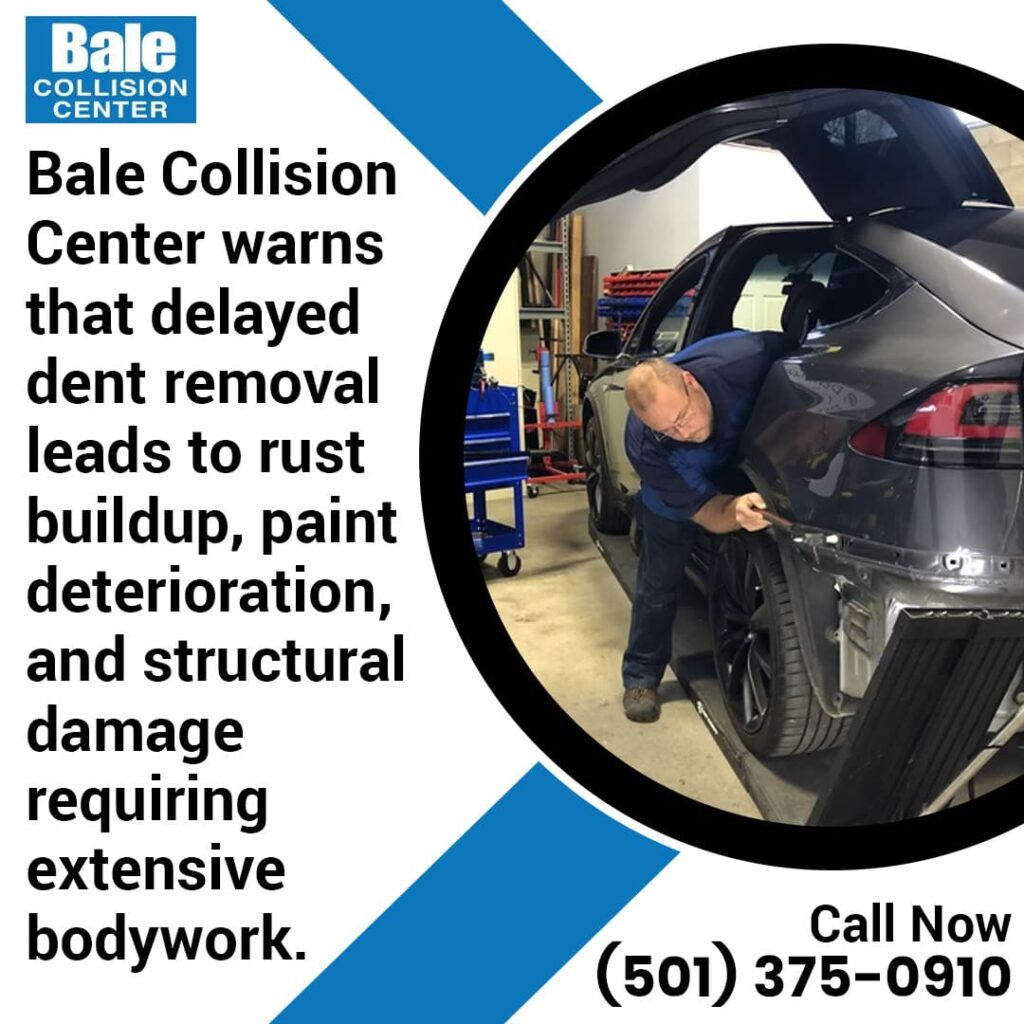
Small dents might seem harmless at first glance, but delaying repair can create escalating problems that become increasingly expensive to address. What starts as a minor cosmetic issue often progresses into rust formation, paint deterioration, and structural concerns that require extensive bodywork. The initial investment of addressing a small dent is minimal compared to the compounding expenses that develop when damage sits untreated for months or years.
Vehicle owners frequently underestimate how quickly Arkansas weather accelerates damage progression. Moisture penetration through compromised paint creates conditions for corrosion that spreads beneath the surface, often becoming visible only after substantial degradation has occurred. Bale Collision Center (Downtown) in Little Rock aims to educate customers about how dents left unaddressed for just a few months transform from straightforward paintless dent repair (PDR) candidates into complex restoration projects requiring traditional bodywork. Understanding the timeline and mechanisms of damage progression helps vehicle owners make informed repair decisions. Professional assessment determines whether paintless dent repair in Downtown Little Rock, AR, can address your damage or if traditional methods better suit your situation based on severity and paint condition.
How Minor Dents Progress Into Major Problems
Paint Integrity Breakdown
The factory finish on vehicles consists of multiple protective layers designed to shield metal from environmental exposure. When an impact creates a dent, it often cracks or weakens these layers even when visible paint damage isn’t immediately apparent. Microscopic cracks in the clear coat allow moisture to reach primer and base layers, starting a degradation process that accelerates with each weather cycle.
Temperature fluctuations common in Little Rock cause expansion and contraction of damaged areas. Summer heat followed by winter cold repeatedly cycles these stresses. This breaks down paint adhesion around the dent perimeter. Paint serves as the primary barrier between vehicle metal and environmental elements. Once this barrier becomes compromised at a dent location, the protective system begins failing.
Clear coat separation allows ultraviolet radiation to degrade underlying color layers. Base coat exposure permits moisture infiltration that reaches the primer and metal surfaces. This progressive breakdown happens gradually but continuously, with each day of exposure worsening the condition.
Moisture Accumulation and Rust Formation
Dented areas trap water more readily than smooth surfaces. Rain, humidity, car washes, and morning dew collect in depressions where natural drainage cannot occur. When bare metal is exposed to moisture and oxygen, corrosion processes can initiate quickly. In Little Rock’s humid environment or after winter road treatments, visible rust may appear sooner than owners expect, and hidden corrosion can develop under the finish if left untreated.
Arkansas humidity levels create ideal conditions for accelerated rust development. The state’s climate combines high moisture content with temperature variations that speed chemical reactions that cause corrosion. Vehicle owners who wait months before addressing dents often discover rust damage extending well beyond the original impact area.
What begins as a contained surface issue transforms into spreading corrosion that affects larger panel sections. Once rust establishes beneath the paint surface, removal requires grinding away affected metal and treating surrounding areas to prevent continued spread. The rust doesn’t stay localized but creeps outward under the paint, where you can’t see it developing.
Structural Weakness Development
Metal fatigue occurs when dented panels experience ongoing stress cycles. The deformed area becomes a weak point that concentrates force during everyday use. Over time, this fatigue can lead to cracking, particularly in high-stress locations like door edges or quarter panels.
A dented door panel near the hinge mounting point experiences repeated stress during every opening and closing cycle. A roof dent undergoes constant flexing during highway driving. Both scenarios accelerate metal fatigue that weakens panel strength. The cumulative effect of thousands of stress cycles on damaged metal creates conditions for sudden failure that wouldn’t occur on properly maintained panels.
Modern vehicles use varied metal thicknesses and alloys chosen for specific performance characteristics. Damage that disrupts these engineered properties compromises the panel’s intended function. High-strength steel and aluminum panels particularly suffer when deformation remains uncorrected.
Financial Impact of Delayed Repair
Repair Complexity Increases Over Time
A small door ding that qualifies for PDR typically involves minimal intervention. When addressed promptly, most minor dents can be removed within hours using specialized tools that preserve the factory finish. Waiting transforms simple repairs into complex projects requiring multiple process stages and extended facility time.
Once rust develops, the affected metal must be treated or replaced entirely. Paint matching, blending, and refinishing across larger areas requires substantially more work. What began as straightforward paintless dent repair becomes a multi-stage restoration process involving rust treatment, metal preparation, filler application, and complete panel refinishing.
The repair scope expands because corrosion damage requires addressing both the original dent and the rust spread, which often extends into adjacent areas. A quarter-sized door ding addressed immediately through PDR requires basic service. After months of Arkansas weather exposure, that same dent with rust formation requires comprehensive bodywork, including rust removal, metal treatment, multiple layers of materials, and refinishing.
Insurance Coverage Complications
Promptly notify your insurer after a storm or impact damage and document the condition. Insurance policies generally require timely reporting and may reduce or deny coverage if an adjuster documents pre-existing damage or prolonged neglect. Policy terms vary, so report loss promptly and keep repair documentation to support any claim.
Vehicles with documented delayed repairs may face higher premiums during policy renewals. Insurance companies view deferred maintenance as increased risk, potentially affecting coverage terms. Prompt repair maintains cleaner vehicle history records that support full coverage and favorable policy terms.
Timely claims filed shortly after damage occurrence receive approval more readily than claims filed months later. Extended delays raise questions about when damage actually occurred and whether other factors contributed to worsening conditions. These complications can result in partial denials or disputes about coverage scope.
Vehicle Value Protection
Resale value drops sharply when visible damage or rust appears during inspections. Buyers and dealerships reduce offers substantially when paint or body condition issues require attention. Even after repair, vehicles with documented corrosion history receive lower valuations than comparable models with clean maintenance records.
Vehicle history services collect records from police reports, insurers, dealerships, and reporting repair facilities. Minor dent repairs completed out of pocket and not reported to insurers often do not appear on vehicle history reports. Repairs performed through an insurance claim or reported by a reporting facility are more likely to show up and can affect buyer perception.
The difference in market perception is substantial. A sedan with a clean history maintains its market valuation, while the same vehicle with documented major bodywork for rust repair experiences reduced buyer interest and lower offers. When vehicle owners choose paintless dent repair in Downtown Little Rock, AR, for prompt service, they maintain full valuation potential without triggering extensive documentation.
Arkansas Climate Factors That Accelerate Damage
Humidity and Temperature Extremes
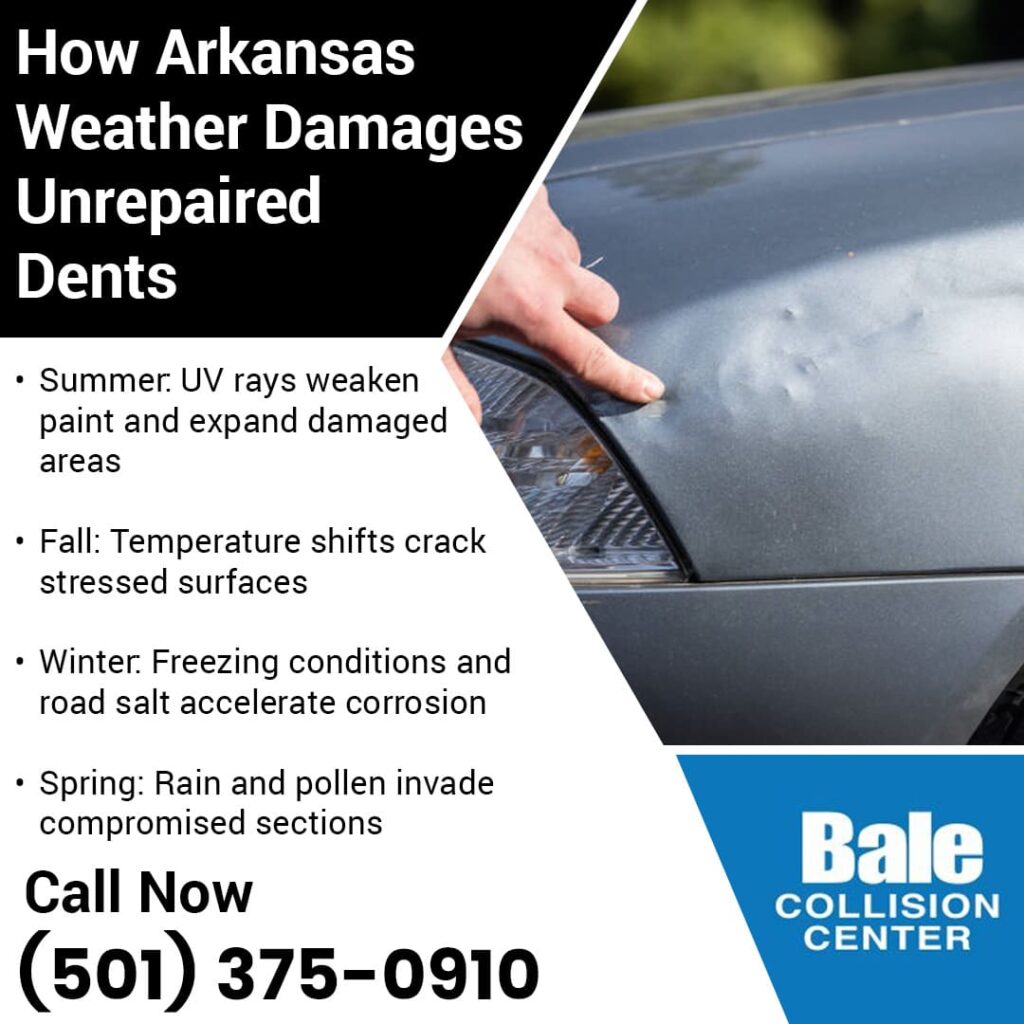
Little Rock experiences substantial seasonal variation that stresses vehicle finishes continuously. Understanding how each season affects unrepaired dents helps vehicle owners recognize the urgency of timely repair.
| Season | Temperature Range | Primary Threat | Impact on Dented Areas |
| Summer | 90°F+ with heat indexes over 105°F | UV radiation and heat expansion | Paint separation accelerates, clear coat breaks down |
| Fall | 70°F to 50°F with frequent fluctuations | Thermal cycling stress | Existing cracks widen, and paint adhesion weakens |
| Winter | Below freezing 50+ days annually | Contraction and road salt exposure | Metal contracts unevenly, and corrosive chemicals penetrate |
| Spring | 50°F to 85°F with high precipitation | Moisture and temperature swings | Water penetration through compromised areas |
Each seasonal transition adds cumulative stress to compromised areas, making prompt car dent removal necessary to prevent progressive deterioration.
Storm Activity and Debris Hazards
Severe weather events occur regularly throughout Arkansas, bringing hail, high winds, and debris that damage vehicles. Arkansas experiences numerous severe weather days annually, with hail events documented in many occurrences.
Arkansas experiences severe hail events that, in some cases, produce hailstones of quarter-inch diameter and larger. These severe hailstorms can cause widespread cosmetic damage and create many PDR or traditional repair needs during active storm seasons. Storm debris, including branches, blown objects, and wind-driven materials, creates additional impact risks.
Vehicles left outdoors face repeated exposure to these hazards, with each incident adding to existing damage or creating new vulnerable areas. Spring hailstorms across central Arkansas have damaged thousands of vehicles in single events. Each storm season brings new risks that compound any existing unrepaired damage.
Road Salt and Chemical Exposure
Arkansas road surfaces contain gravel, sand, and other abrasive materials that strike vehicle panels regularly during normal driving. Highway speeds amplify impact force, creating small dents and paint chips that serve as starting points for corrosion.
State and city crews use salt brine and sand/salt mixes to treat roads during winter events. These deicing materials can increase corrosion risk where they contact exposed metal. After winter storms or icy road treatments, rinsing the undercarriage and wheel wells helps remove corrosive residues and reduce accelerated rusting.
The state applies substantial quantities of road salt annually across highways, with higher concentrations in urban areas like Little Rock. Vehicles parked near construction sites face additional exposure to concrete dust, metal particles, and chemical runoff that settle on surfaces and accelerate paint breakdown.
Professional Assessment Advantages
Early Detection Through Expert Inspection
Certified technicians identify damage characteristics that determine repair urgency and method selection for car dent removal. Professional inspection reveals hidden concerns that owners might miss, including paint cracking invisible to untrained eyes and rust initiation in early stages.
At Bale Collision Center, our I-CAR Platinum-certified technicians provide thorough damage evaluation using specialized equipment and decades of experience.
Advanced diagnostic tools detect damage characteristics that determine the best repair approach. Specialized equipment reveals paint stress points and assesses dent depth to determine whether certified PDR remains viable or traditional methods become necessary. These technologies enable our technicians to recommend the most effective dent removal services while the repair remains straightforward and preserves your vehicle’s factory finish.
Early intervention keeps repair requirements manageable while protecting your vehicle’s long-term value. Timely assessment identifies the most effective solution before environmental factors worsen the damage.
Choosing the Right Repair Method
PDR remains viable only when specific conditions exist. Paint integrity, metal flexibility, dent depth, and access points all influence whether this method can achieve proper results. Professional evaluation determines which approach serves the vehicle best, preventing inappropriate repair attempts that waste resources while allowing damage to progress.
Traditional bodywork becomes necessary when paint damage, rust formation, or metal stretching exceeds PDR capabilities. Metal stretched beyond its elastic limit cannot return to its original shape through PDR techniques alone. Each scenario demands different expertise and processes that professionals can match to specific damage characteristics.
A golf ball-sized door dent with intact paint qualifies for paintless dent repair. The same dent with a paint chip requires traditional repair because paint refinishing becomes necessary. A similar dent with rust formation requires more extensive work because metal treatment adds complexity before paint application.
Timing Your Dent Repair Decision
Several factors should guide decisions about repair timing. Paint condition remains the primary consideration since an intact finish indicates PDR viability, while visible rust, paint chips, or clear coat damage require immediate attention.
Dent location affects urgency based on moisture exposure patterns:
- Horizontal surfaces (hoods and roofs): Collect standing water during rain. Prompt repair is required to prevent rust formation.
- Lower body panels near wheel wells: Experience constant road spray and splash exposure. Needs immediate attention.
- Vertical panels (doors, fenders): Better natural drainage allows slightly longer wait times if paint remains intact.
- Areas near drainage channels: Water pooling accelerates rust formation, requiring quick action.
Dent depth influences repair complexity and available options:
- Shallow depressions (less than 1/4 inch): Respond well to certified PDR when paint is intact.
- Moderate depths (1/4 to 1/2 inch): May qualify for paintless dent repair depending on metal type and paint flexibility.
- Deep dents (over 1/2 inch): Typically require traditional methods with refinishing.
Understanding these priority differences helps owners allocate resources appropriately while preventing the most threatening damage from progressing.
Trust Bale Collision Center for Expert Car Dent Removal Services
Bale Collision Center maintains I-CAR Gold certification and employs certified technicians who understand the nuances of dent repair timing and method selection. With 72 years of service in Arkansas, we’ve developed expertise in evaluating how local conditions affect vehicle damage progression. Our facility capabilities include:
- Advanced diagnostic equipment for thorough damage assessment
- Certified PDR technology and traditional repair capabilities under one roof
- Professional-grade tools for precise metal manipulation and paint restoration
- Computerized paint matching systems for seamless refinishing when needed
Our team provides transparent communication throughout the repair process, explaining your options and helping you understand whether certified PDR or traditional methods best serve your situation. Every repair at our shop follows OEM procedures and includes quality inspection before delivery.
Protecting Your Vehicle Investment
Small dents rarely remain small problems. Arkansas weather conditions, moisture exposure, and temperature cycling transform minor cosmetic concerns into expensive structural issues requiring extensive work. Acting promptly preserves vehicle value, maintains safety standards, and keeps repair requirements at their most manageable levels.
Regular vehicle inspection identifies new damage promptly. Checking panels after storms, parking lot use, or highway driving helps catch dents when they remain simple to address through dent removal services.
Professional evaluation determines the most effective approach for your specific situation. Our certified team at Bale Collision Center offers both traditional bodywork and paintless dent repair in Downtown Little Rock, AR, providing honest assessments and quality workmanship backed by decades of local service. Bale Automotive traces its family dealership roots to 1912, and the collision center has served the Little Rock community since 1952.
Protect your investment with expert services from experienced professionals. Contact us at (501) 375-0910 or email bccdowntown@baleautomotive.com to schedule your evaluation. Address minor damage now before it becomes a major concern requiring extensive intervention.

